


Looking for proven ways to increase Shopify sales? The most effective strategies center on four key levers: conversion rate optimization, improving traffic quality, raising your average order value, and building customer retention.
In this guide, you’ll find 10 actionable, research-backed tactics that Shopify store owners at any level can implement to see real revenue growth, no guesswork, no fluff.
If your Shopify store isn’t growing the way you expected, “get more traffic” is probably the wrong answer. Most stores leak revenue through poor product pages, and no amount of Shopify marketing tips about traffic will fix that, slow load times, abandoned carts, and weak retention, not a lack of visitors.
Consider this: the average Shopify conversion rate sits between 1.4% and 1.8%, while top-performing stores exceed 3.2%. That means most stores convert fewer than 2 out of every 100 visitors.
Meanwhile, the average cart abandonment rate is 70.19% according to Baymard Institute’s 2025 meta-analysis of 48+ studies.
Small, targeted improvements compound fast. Boosting your conversion rate from 1.5% to 2.5% on 10,000 monthly sessions at a $75 AOV means increasing monthly revenue from $11,250 to $18,750—a 67% increase without spending a dollar more on ads.
This post outlines 10 proven ways to increase Shopify sales, along with the exact steps to implement each.
What Drives Shopify Sales Growth?
Before jumping into tactics, understand the four levers that drive every dollar of Shopify revenue:
- Traffic: Quality over quantity. 1,000 high-intent visitors beat 10,000 casual browsers.
- Conversion Rate (CRO): The percentage of visitors who actually buy.
- Average Order Value (AOV): How much each customer spends per transaction.
- Repeat Purchases (Retention/LTV): How often customers come back to buy again.
Here’s the simple revenue formula every Shopify merchant should know:
Revenue = Traffic × Conversion Rate × Average Order Value
Most merchants obsess over traffic (lever #1) while ignoring the other three. The highest-ROI improvements almost always come from Shopify conversion rate optimization, raising AOV, and increasing repeat purchases.

Bring your ideas to life for $1/month
The future of business is yours to shape. Sign up for a free trial and enjoy 3 months of Shopify for $1/month on select plans.
10 Proven Ways to Increase Shopify Sales
1. Optimize Your Product Pages for Conversion
What it is: Your product page is where the buying decision happens. Shopify product page optimization means refining every element—images, copy, CTAs, and social proof—to remove friction and drive “Add to Cart” clicks.
Why it works: A well-optimized product page can lift conversion rates by 20–40%. Most Shopify stores use generic descriptions and a single product image, which kills buyer confidence.
How to implement:
- Use 5–8 high-quality product images (lifestyle + white background + detail shots)
- Write benefit-driven descriptions, not feature lists
- Add urgency elements: stock counters, countdown timers, or “selling fast” badges
- Display star ratings and review counts prominently above the fold
- Include a clear, visible CTA button with action-oriented text (“Add to Cart” or “Buy Now”)
- Add trust signals: shipping info, return policy, and payment icons near the CTA
Tools that help: Use a fast, conversion-focused Shopify theme with built-in badges, countdowns, and flexible sections so you avoid bloating your store with too many apps. For social proof, apps like GroPulse Google Reviews can import and display authentic Google reviews directly on your product pages.
Benchmark: Stores that implemented 25+ CRO changes on product pages achieved a record 4.92% conversion rate with a 12× ROI.
2. Improve Store Speed and Mobile UX
What it is: Site speed refers to how quickly your pages load. Mobile UX is about how intuitive and frictionless the shopping experience is on phones and tablets.
Why it works: A 1-second delay in page load reduces conversions by 7%, and 53% of mobile users leave a site that takes longer than 3 seconds to load. Pages that load in 1 second have 3× higher conversion rates than pages loading in 5 seconds. With over 60% of ecommerce traffic coming from mobile devices, a slow or clunky mobile experience directly reduces Shopify sales.
How to implement:
- Compress images before uploading (WebP format loads 25–35% faster)
- Minimize installed apps, each app adds JavaScript that slows your site
- Use a lightweight, performance-optimized Shopify theme (theme speed is one of the biggest factors)
- Enable lazy loading for images below the fold
- Test your store with Google PageSpeed Insights and aim for 90+ on mobile
- Ensure tap targets are large enough and navigation is thumb-friendly
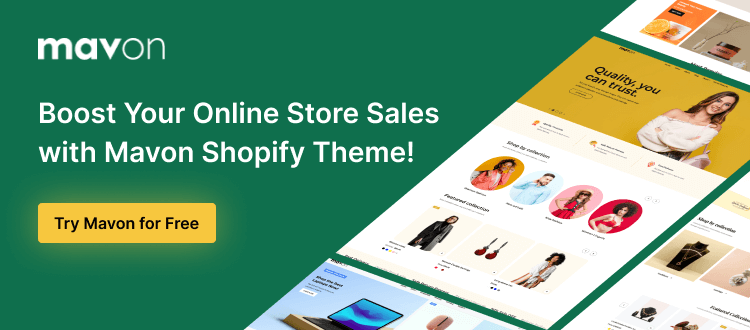
Tools that help: Choosing a speed-optimized theme is the single biggest win. Mavon Shopify theme by Gloryio is optimized for performance with Google PageSpeed and includes built-in features that eliminate the need for multiple third-party apps—a common cause of bloated load times.
Benchmark: Improving load time from 3s to 1s can reduce bounce rates by up to 32%. Yelp reported a 15% increase in conversion rates after page speed optimization.
3. Add Upsells, Cross-Sells, and Bundles
What it is: Upselling encourages customers to buy a higher-priced version; cross-selling suggests complementary products; bundling groups items at a discount.
Why it works: According to Accenture and Forrester research, upselling and cross-selling collectively generate 10–30% of all eCommerce revenues. Upsell conversion rates average approximately 20%. The right Shopify upsell apps make this easy to implement. This makes it one of the highest-ROI tactics to increase average order value on Shopify.
How to implement:
- Add a “Frequently Bought Together” section on product pages
- Offer bundle discounts (e.g., “Buy 2, Get 10% Off”)
- Show post-purchase upsells on the thank-you page (one-click add)
- Use volume discounts (tiered pricing) to incentivize larger orders
- Place cross-sell suggestions in the cart drawer
Tools that help: The GP Wishlist & Upsell Suite by GroPulse offers upsell offers on product and cart pages, product bundles with discounts, volume discounts, and smart product recommendations—all from a single free app.
Benchmark: Effective upselling and cross-selling strategies typically increase AOV by 10–40%, with personalized recommendation engines achieving 25–30% AOV improvements.
4. Build Trust with Reviews, Guarantees, and Clear Policies
What it is: Trust signals are elements on your store that reduce perceived risk—reviews, money-back guarantees, clear shipping/return policies, and security badges.
Why it works: 47% of customers abandon carts due to unexpected extra costs like shipping and taxes appearing at checkout. An unsatisfactory return policy causes 18% of cart abandonments. Transparent policies and authentic reviews directly reduce these friction points.
How to implement:
- Display customer reviews on product pages and a dedicated reviews page
- Show a money-back guarantee badge near your “Add to Cart” button
- Make your shipping policy, delivery estimates, and return/refund process visible on every product page
- Add trust badges (secure checkout, accepted payment methods) in the footer and near checkout
- Use real Google reviews for credibility—they carry more weight than on-site reviews alone
Tools that help: GroPulse Google Reviews imports authentic Google reviews and displays them as customizable widgets on your store, boosting credibility with real third-party validation. The Mavon theme also includes built-in trust badges and testimonial sections.
Recommended Blogs for You:
👉 How to Add Shopify Schema Markup for Better SEO: Step-by-Step Guide
👉 Shopify Success Rate in 2026: Why Most Stores Fail (and How to Win)
👉 How to Start a T-Shirt Business in 24 Hours on Shopify
👉 Shopify SEO: How To Generate More Store Traffic (2025)
5. Fix Cart Abandonment with Email and SMS Automation
What it is: Automated email and SMS sequences that trigger when a shopper adds items to their cart but doesn’t complete checkout.
Why it works: With 70.19% of carts abandoned and $18 billion in annual revenue lost to cart abandonment, recovery flows are essential. Shopify email marketing automation is one of the most cost-effective revenue channels available. Cart recovery emails convert at 10.7%, with top performers hitting 20%+. Email marketing delivers an average ROI of $36–$40 for every $1 spent.
How to implement:
- Set up a 3-email abandoned cart sequence:
- Email 1 (1 hour after): Reminder with cart contents
- Email 2 (24 hours): Add social proof or address objections
- Email 3 (48–72 hours): Offer a small discount or free shipping
- Add SMS reminders for high-value carts (SMS has higher open rates than email)
- Include a direct link back to the cart in every message
- A/B test subject lines, send times, and discount amounts
Tools that help: Shopify has built-in abandoned checkout recovery. For more advanced flows, Klaviyo and Omnisend are popular choices. Use Analyzely by GroPulse to track which traffic sources produce the highest cart abandonment rates, so you can target your recovery efforts effectively.
6. Improve Checkout Experience and Reduce Friction
What it is: Shopify checkout optimization means removing every unnecessary step, field, and distraction between “Add to Cart” and “Order Confirmed.”
Why it works: A long or complicated checkout process causes 22% of abandonments, while 21% abandon because they can’t see the total cost upfront. If you want to reduce cart abandonment on Shopify, start at checkout. Reducing friction has a direct, measurable impact on completed purchases.
How to implement:
- Enable Shopify’s one-page checkout (or Shop Pay for returning customers)
- Offer guest checkout—don’t force account creation
- Show the full cost (including shipping and taxes) as early as possible
- Provide multiple payment options: credit card, Shop Pay, PayPal, Apple Pay, Google Pay
- Reduce form fields to the bare minimum
- Add progress indicators so customers know where they are in the process
Benchmark: Stores that reduced their checkout from 5 steps to 2 saw conversion improvements of 10–35%.
7. Use High-Intent Traffic Sources (SEO + Paid + Influencer)
What it is: Focus marketing spend on channels that bring visitors who are already looking to buy, rather than broad awareness traffic.
Why it works: Social media traffic has the highest cart abandonment rate at 91%, while search traffic performs significantly better. High-intent traffic—from SEO, Google Shopping, and targeted influencer campaigns—converts at multiples of generic social traffic.
How to implement:
- SEO: Optimize product pages and collection pages for transactional keywords. Use structured data (schema markup) to get rich snippets in Google search results—star ratings, prices, and availability.
- Google Shopping / Performance Max: Feed-based ads that show your products to people actively searching.
- Influencer partnerships: Work with micro-influencers (10K–50K followers) in your niche for authentic, high-converting traffic.
- Retargeting: Use Meta/Google retargeting to bring back visitors who viewed products but didn’t buy.
Tools that help: GP JSON-LD Schema & AI SEO by GroPulse automatically adds structured data to your store so your products appear with star ratings, prices, and availability in Google search results—boosting click-through rates without ongoing effort. It also includes AI-powered meta tag generation and Google Search Console integration.
For deeper SEO strategies, check out the guide on how to optimize Shopify store SEO for rankings.
8. Run Smarter Promotions (Not Constant Discounts)
What it is: Strategic, time-limited promotions designed to create urgency and move specific inventory—rather than store-wide discounts that erode margins.
Why it works: Constant discounting trains customers to wait for sales and destroys brand value. Smart promotions create urgency, reward loyalty, and protect margins.
How to implement:
- Use flash sales with countdown timers (24–48 hours max)
- Offer free shipping thresholds above your current AOV (e.g., “Free shipping on orders over $75”)
- Create exclusive offers for email subscribers or loyalty members only
- Use “Buy X, Get Y” promotions instead of flat percentage discounts
- Announce sales via a free shipping bar or announcement bar on your store
Tools that help: GroPulse offers a dynamic free shipping bar with advanced targeting to incentivize higher cart values.
SalesPulse by GroPulse adds social proof pop-ups showing recent orders, creating urgency without discounting.
Quick example: A store that switched from “20% off everything” to “Free shipping over $65 + Buy 2 Save 15%” saw their AOV increase from $52 to $78 while maintaining a healthier margin.
9. Increase Repeat Purchases with Loyalty and Retention Flows
What it is: Shopify retention strategies that bring customers back—loyalty programs, post-purchase email sequences, replenishment reminders, and personalized offers.
Why it works: Acquiring a new customer costs 5 to 25 times more than retaining an existing one. A 5% increase in customer retention can boost profits by 25–95%. Existing customers have a 60–70% purchase success rate compared to just 5–20% for new prospects. Retention-focused companies grow 2.5× faster than those focused solely on acquisition.
How to implement:
- Set up a post-purchase email flow: Thank you → How-to-use/tips → Cross-sell → Reorder reminder
- Launch a simple loyalty/rewards program (points per purchase, birthday rewards)
- Use wishlist data to send price-drop alerts and back-in-stock notifications
- Segment your email list by purchase history and send personalized product recommendations
- Offer subscription/auto-replenish options for consumable products
Tools that help: GP Wishlist & Upsell Suite includes wishlist reminders, back-in-stock alerts, and price drop notifications to re-engage past visitors automatically.
10. Use Analytics and A/B Testing to Scale Winners
What it is: Data-driven decision making—tracking your Shopify sales funnel, identifying drop-off points, and running A/B tests to validate improvements.
Why it works: You can’t improve what you don’t measure. Stores that consistently test and iterate grow faster because they scale what works and cut what doesn’t.
How to implement:
- Set up Google Analytics 4 with proper ecommerce event tracking (view_item, add_to_cart, begin_checkout, purchase)
- Monitor your conversion funnel weekly: Homepage → Collection → Product → Cart → Checkout → Purchase
- Identify the biggest drop-off in your funnel and focus on improvements there first
- A/B test one change at a time: headlines, images, button colors, pricing, page layout
- Track AOV, conversion rate, and revenue per visitor as your north-star metrics
Tools that help: Analyzely by GroPulse provides seamless GA4 integration with server-side event tracking, ecommerce reports, and AI-powered analysis, all without coding. It makes it easy to see which products, pages, and traffic sources are driving (or losing) revenue.
Common Mistakes That Reduce Shopify Sales
Even strong stores sabotage their growth with these common pitfalls:
- Running discounts too often: Trains customers to never buy at full price. Use strategic promotions instead of perpetual sales.
- Sending paid traffic to weak product pages: Driving traffic to pages with one image, a thin description, and no reviews is burning ad budget.
- Slow site speed: Every second of delay costs you conversions. Audit your theme and apps regularly.
- Unclear shipping and return policies: Ambiguity creates anxiety. Show shipping costs early and make return policies easy to find.
- Too many popups: Newsletter popup + exit intent + spin-to-win + cookie consent = visitor frustration. Limit to 1–2 well-timed pop-ups at most.
- Not tracking the conversion funnel: If you don’t know where visitors drop off, you’re guessing. Set up proper analytics before spending on ads.
Quick Wins vs. Long-Term Wins
| Tactic | Time to Implement | Impact | Best For |
| Add trust badges & clear shipping info | 1–2 hours | Medium | All stores |
| Set up cart abandonment emails | 2–4 hours | High | Stores with traffic |
| Compress images & enable lazy loading | 1–2 hours | Medium | Slow-loading stores |
| Add upsells/cross-sells to cart | 2–3 hours | High | Stores with 3+ products |
| Install a free shipping bar | 30 minutes | Medium | Stores with low AOV |
| Optimize product page copy & images | 1–2 days | High | All stores |
| Switch to a faster Shopify theme | 1–2 weeks | Very High | Stores on slow themes |
| Build post-purchase email flows | 1–2 weeks | High | Stores with 100+ customers |
| Launch a loyalty/rewards program | 2–4 weeks | High | Established stores |
| Implement structured A/B testing | Ongoing | Very High | Stores with 5K+ monthly sessions |
Recommended Shopify Tools
| Category | Tool | What It Does |
| Analytics & Tracking | Analyzely – Google Analytics 4 | GA4 integration, ecommerce event tracking, AI analysis |
| SEO & Rich Snippets | GP JSON-LD Schema & AI SEO | Schema markup, rich snippets, AI meta tags, Search Console |
| Social Proof & Reviews | GroPulse Google Reviews | Import & display Google reviews, customizable widgets |
| Wishlists & Upsells | GP Wishlist & Upsell Suite | Wishlists, upsells, bundles, volume discounts, reminders |
| Social Proof Pop-ups | SalesPulse – Sales Pop Up | Recent order notifications, announcement bars |
| Store Theme | Mavon by Gloryio | Fastest Shopify theme, 20+ sections, built-in conversion features |
🚀 Ready to skyrocket your Shopify store to success?
🚀 Unlock the secrets to success and boost your sales 📈 with ShopiBuffet’s expert services. Don’t miss out, get started now!
Frequently Asked Questions
What are the fastest ways to increase Shopify sales?
The fastest wins are fixing cart abandonment with automated recovery emails, adding trust signals (reviews, guarantees, clear policies) to product pages, and implementing upsell/cross-sell offers. These can be set up in hours and often produce measurable results within the first week.
How do I increase AOV on Shopify?
The most effective ways to increase average order value on Shopify include adding product bundles, offering volume/tiered discounts, setting free shipping thresholds just above your current AOV, and using post-purchase one-click upsells. Successful stores achieve AOV lifts of 10–40% with these tactics.
What conversion rate is good for Shopify?
The average Shopify conversion rate is 1.4%–1.8%. A “good” rate is 2%–3%, which puts you above average. Stores converting at 3.2%+ are in the top 20%, and those hitting 4.7%+ are in the top 10%. For Shopify CRO tips specific to your niche, your target should depend on your industry—digital products convert higher (3.5%–5%) while electronics are lower (1%–1.7%).
How can I reduce cart abandonment?
Show all costs (shipping, taxes) upfront, simplify your checkout process, offer guest checkout, provide multiple payment methods, and set up a 3-email cart recovery sequence. Since 47% of abandonment happens due to surprise costs and 22% due to complicated checkout, addressing these two issues has the biggest impact.
Which Shopify apps help increase sales?
Key app categories include analytics (Analyzely for GA4 tracking), SEO (GP JSON-LD Schema for rich snippets), reviews (GroPulse Google Reviews), upselling (GP Wishlist & Upsell Suite), and social proof (SalesPulse). Choose a fast theme like Mavon that includes built-in features to minimize app bloat.
Final Word
Strong Shopify growth rarely comes from “more traffic” alone. Sustainable results come from combining Shopify conversion rate optimization, faster theme speed and UX, strategic upsells to increase average order value, and retention flows that turn first-time buyers into repeat customers.
When these four levers work together—quality traffic, a high-converting Shopify sales funnel, optimized checkout, and consistent post‑purchase marketing- you get compounding gains instead of one‑off spikes.