


Shopify wishlist apps allow shoppers save and return to products they love without committing to checkout, which reduces friction and massively increases the chances they come back and buy. Shopify App store platforms like GroPulse, Wishlist Plus, and Hulk Apps combine wishlists with reminders, upsells, and back‑in‑stock alerts so you can retarget warm intent, increase AOV, and turn “maybe later” traffic into revenue.
Key Takeaways
- Wishlists increase return visits and AOV
- Guest wishlists reduce friction
- Back-in-stock alerts recover lost revenue
- Wishlist data improves email remarketing
- Smart upsell integration drives higher conversions
A shopper browses five products, compares colors and sizes, but never hits “Add to cart” and bounces. Two days later, they came back and bought because they’d quietly saved their favorites to a wishlist that emailed them a reminder and a small incentive.
That’s how a well‑implemented Shopify wishlist app turns window shoppers into customers — it lowers commitment, lets people “Shop now, decide later,” and gives you a clean data trail of what they actually want.

Bring your ideas to life for $1/month
The future of business is yours to shape. Sign up for a free trial and enjoy 3 months of Shopify for $1/month on select plans.
In stores we’ve configured, we almost never treat “Add to Cart” as the only intent signal, because it’s too big a step for early‑stage browsers; a wishlist or “Save for later” feels safer and gets far more engagement.
Once that intent is captured, wishlist data feeds back‑in‑stock alerts, price‑drop emails, and personalized upsells, so you’re not guessing which products to promote — you’re following the customer’s own signals.
Why Your Shopify Store Needs a Wishlist App
- Reduce buying hesitation by offering a low‑commitment way to save products instead of forcing an “Add to cart” decision.
- Increase repeat visits because shoppers come back specifically to review and complete items they’ve already saved.
- Capture shopper intent at a product level, even when people never reach checkout, giving you a clearer picture than generic traffic analytics.
- Improve email marketing by triggering reminder, price‑drop, and back‑in‑stock flows tied to each customer’s saved items.
- Enable product‑based upselling by recommending complementary or higher‑value items around a visitor’s wishlist or saved products.
- Collect demand insights (most‑saved products, frequently wished but rarely purchased items) to inform merchandising, pricing, and inventory decisions.
In Shopify stores we’ve optimized, enabling wishlist + reminder emails typically increases returning customer purchases by 15–25% within the first month because you’re re‑engaging people who already raised their hand and said, “I like this product,” instead of retargeting cold audiences.
What are the Top Shopify Wishlist and Upsell Apps in 2026?
- GP ‑ Wishlist & Upsell Suite
- Swym Wishlist Plus
- Hulk Wishlist & Favorites
- Growave: Loyalty & Wishlist
- Mst: Wishlist + Marketing flow
GroPulse Wishlist (GP ‑ Wishlist & Upsell Suite)
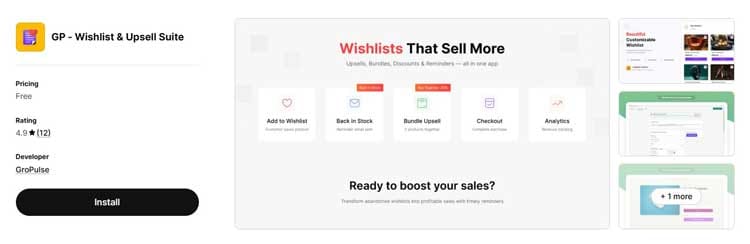
GroPulse Wishlist is a combined wishlist and upsell suite designed to recover lost intent and increase average order value with minimal setup. Shoppers can save and share favorites, while the app fires automated reminders, price‑drop alerts, and back‑in‑stock notifications that bring them back to buy.
In stores we’ve configured, the clean UI and performance‑optimized widget mean we can add “Save” options without slowing pages or cluttering the product card. Because upsells, bundles, and volume discounts live in the same app, it’s easier to build cohesive funnels instead of stitching together multiple tools.
Key Features
- Guest and account‑based wishlists with social sharing.
- Upsell offers on product and cart pages to increase AOV.
- Product bundles and tiered volume discounts to grow cart size.
- Wishlist reminders, price‑drop, and back‑in‑stock alerts via email.
- Advanced analytics on clicks, orders, and revenue from wishlists and upsells.
- Smart product recommendations based on wishlist behavior.
Pros and Cons:
Pros
- Easy setup with app embed and automatic placement on product/collection cards.
- Combines wishlist, upsells, bundles, and reminders in a single lightweight app.
- Supports guest wishlists and social sharing, which boosts adoption and virality.
Cons
- Advanced configurations (custom layouts, complex funnels) may still need theme edits or dev help in some themes.
- Newer app, so fewer ecosystem integrations than long‑standing enterprise tools like Growave.
Best For: Merchants who want a lightweight wishlist app that also covers core AOV plays (upsells, bundles, volume discounts) without juggling multiple tools. Ideal for small to mid‑size Shopify stores that care about performance and need guest wishlists plus simple but useful analytics.
Pricing: Free plan with wishlists, reminders, back‑in‑stock alerts, upsell offers, volume discounts, and bundles included.
Wishlist Plus by Swym
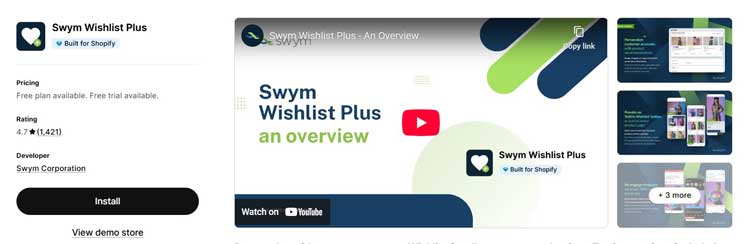
Wishlist Plus by Swym is a popular Shopify wishlist app focused on cross‑device persistence, deep integrations, and scalable remarketing workflows. It’s widely used by mid‑market and enterprise brands that want robust analytics, Shopify Plus support, and strong connections to tools like Klaviyo and Attentive.
In most cases where we’re working with heavier traffic and complex stacks, Swym’s session‑ and account‑based wishlists give us reliable data to plug into flows, ads, and CDPs.
Key Features
- Save‑for‑later and wishlist buttons on product and cart pages.
- Cross‑device and account‑based syncing of wishlists.
- Integrations with Klaviyo, Attentive, Yotpo, Mailchimp, and Shopify POS.
- Automated wishlist and “Saved for later” reminder emails.
- Advanced analytics and reporting on wishlist engagement and conversions.
- Support for Shopify Plus, Flow, and higher‑volume operations on Pro/Premium tiers.
Pros and Cons:
Pros
- Strong ecosystem integrations for email, SMS, and reviews, ideal for marketing teams.
- Scalable plans with support for high monthly sessions and advanced customization.
- Good “Save for later” flows from cart, not just classic wishlists.
Cons
- Free plan is limited by lifetime wishlist actions and may not work long‑term for growing stores.
- Pricing scales with traffic and features, which can become expensive for smaller merchants.
Best For: Brands that already rely on tools like Klaviyo, Attentive, or Yotpo and want a deeply integrated wishlist app with advanced analytics and Shopify Plus support. Best suited to mid‑size and enterprise Shopify stores with structured retention marketing.
Pricing: Free plan available; paid plans (Starter, Pro, Premium, Enterprise) scale by sessions and feature depth, starting around lower‑tier monthly fees and increasing with volume.
HulkApps Wishlist (Hulk Wishlist & Favorites)
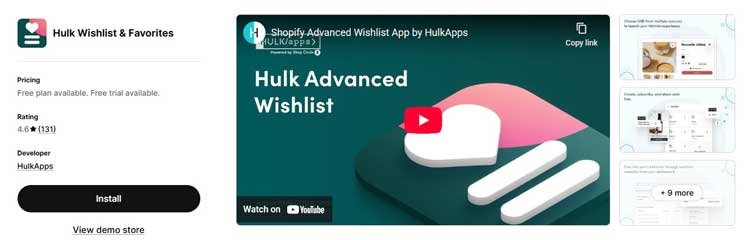
Hulk Wishlist & Favorites is a budget‑friendly yet feature‑rich wishlist app that focuses on sharable lists, guest access, and restock/price‑drop notifications. It lets shoppers save products for later, create multiple lists or gift registries, and share them via email or social media, which is especially useful for gift‑driven verticals.
In stores we’ve configured, it’s often a solid pick when merchants want strong wishlist basics with good customization but need to keep subscription costs under control.
Key Features
- One‑click setup for a customizable wishlist page and icons.
- Guest wishlists and multiple wishlists/gift lists support.
- Email reminders for price drops, low stock, and restocks.
- Social sharing of wishlists via link, email, or social platforms.
- Analytics dashboard for most‑saved products and wishlist engagement.
- Multilingual support and integrations with analytics pixels (Meta, GA4).
Pros and Cons:
Pros
- Strong feature set for the price, including guest wishlists and sharing.
- Good fit for gift‑heavy stores (holidays, registries, B2B quotes) thanks to multiple lists.
- Customizable design that can be aligned with brand quickly.
Cons
- Upsell features are limited compared to dedicated upsell/bundle suites.
- Interface and customization UX can feel less streamlined than newer apps like GroPulse for some themes.
Best For: Stores that want a cost‑effective wishlist with guest support, shareable lists, and email reminders, without needing complex upsell engines. Works well for fashion, gifting, and general catalogs that rely on repeat consideration.
Pricing: This plugin has a free or low‑entry tier; paid plans unlock more customization and advanced features, staying competitive for budget‑conscious merchants.
Growave: Loyalty & Wishlist
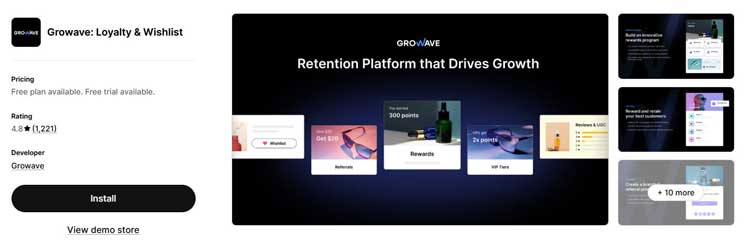
Growave is an all‑in‑one loyalty, reviews, referrals, and wishlist platform built to centralize customer retention in a single app. It’s designed for brands that prefer one integrated system over multiple separate tools, tying wishlists to loyalty points, review requests, and referral incentives.
When we work with stores ready to invest in a retention “stack in a box,” Growave often comes up because of its breadth, not because it’s the simplest wishlist alone.
Key Features
- Wishlists connected to loyalty programs, referrals, and product reviews.
- Back‑in‑stock wishlist emails and nudges for saved products.
- Customizable emails, loyalty pages, and on‑site widgets.
- VIP tiers, points expiration, and gift cards on higher plans.
- Shopify POS and Shopify Flow integrations, plus QR‑based loyalty.
- Integrations with Klaviyo and other marketing tools.
Pros and Cons:
Pros
- Combines wishlist, loyalty, reviews, and referrals in one ecosystem, reducing app sprawl.
- Strong for retention marketing and customer lifetime value strategies.
- Supports more complex programs (VIP tiers, POS loyalty, QR, gift cards) as you scale.
Cons
- Pricing is significantly higher than standalone wishlist apps, especially on Growth/Plus.
- Can feel heavy if you only need a simple wishlist and basic emails.
Best For: Growing brands that want to centralize wishlist, loyalty, and social proof into one scalable retention platform. Best for mid‑size and larger stores that have the budget and bandwidth to configure a comprehensive rewards ecosystem.
Pricing: Free plan with limited orders; paid plans start around 49 USD/month and scale to 199 USD+ and higher tiers with more orders and advanced loyalty features.
Mst: Wishlist + Marketing flow
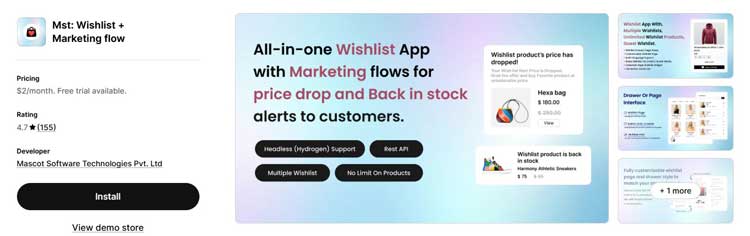
Mst: Wishlist is a simple, feature‑packed wishlist app that focuses on flexibility and broad theme compatibility. It supports multiple and guest wishlists, and lets shoppers save and manage favorites from any device without friction.
In stores we’ve configured that already have separate upsell and email stacks, Mst: Wishlist often works well as a straightforward wishlist layer that stays out of the way.
Key Features
- Multiple wishlists per customer, including guest wishlists.
- Price‑drop and back‑in‑stock alerts via email, SMS, and push notifications.
- No limit on wishlist items or customers.
- Fully customizable wishlist page with Liquid/HTML/CSS, supporting various UI layouts.
- Responsive design with multi‑language and multi‑currency support, plus APIs for headless setups.
Pros and Cons:
Pros
- Flexible design options and multiple UI types (page, drawer, etc.).
- Guest wishlist support alongside multiple lists, which is great for segmenting use cases.
- Advanced alerts, including SMS and push, for higher‑touch remarketing.
Cons
- Does not prioritize built‑in upsell or bundle logic; you’ll rely on separate apps for AOV plays.
- More technical customization (Liquid, CSS) may need dev resources for pixel‑perfect alignment.
Best For: Stores that want a customizable, stand‑alone wishlist with strong notification options and are comfortable handling upsells via other apps. Good fit for brands with custom themes or headless approaches that need API access.
Pricing: Paid app with no explicit free tier on many listings; pricing is usually positioned as affordable relative to its feature set and unlimited wishlists.
Shopify Wishlist and Upsell App Comparison
| Feature | GroPulse | Swym Wishlist Plus | Hulk Wishlist | Growave | Mst: Wishlist |
| Free Plan | ✅ Free tier with core wishlist and upsell features. | ❌ Free tier is limited by wishlist actions and often used as trial. | ✅ Free/low‑tier option with core wishlist features. | ❌ A powerful free limit exists, but serious use is on paid plans. | ❌ Primarily paid, positioned as an affordable premium. |
| Guest Wishlist | ✅ Guest wishlists supported. | ✅ Guest and session‑based wishlists. | ✅ Guest lists and multiple gift lists. | ✅ Supports anonymous wishlists via its widgets. | ✅ Guest wishlist support included. |
| Upsell Integration | ✅ Built‑in upsells, bundles, and volume discounts. | ⚠️ Wishlist data feeds into emails/ads; upsells via other tools. | ❌ Primarily wishlist, sharing, and reminders, not dedicated to upsell logic. | ⚠️ Indirect AOV lift via loyalty/rewards nudges and reviews, not classic upsell widgets. | ❌ Focused on wishlist and alerts; upsells handled externally. |
| Shareable Lists | ✅ Share via social and direct links. | ✅ Social and email sharing of wishlists. | ❌ Mainly focuses on wishlist and gift lists; sharing is less central in basic tiers. | ✅ Wishlist tied to accounts and loyalty, with sharing and UGC options. | ✅ Sharing is supported for wishlists. |
| Email Reminder | ✅ Reminder, price‑drop, and back‑in‑stock emails. | ✅ Automated wishlist and saved‑for‑later reminders. | ✅ Email reminders for favorites and restocks. | ✅ Back‑in‑stock and wishlist‑linked emails plus loyalty messages. | ✅ Email alerts for price drop and restock; plus SMS/push. |
| Analytics | ✅ Wishlist and upsell analytics for clicks, orders, and revenue. | ✅ Wishlist activity and performance reports. | ✅ Dashboard for most‑saved items and wishlist activity. | ✅ Rich analytics around loyalty, reviews, and wishlist engagement. | ✅ Reporting on wishlist usage and alert performance. |
| Rating | 4.9 / 5 (Shopify App Store). | High 4+ range, widely used by larger brands. | High 4+ rating across Hulk’s wishlist listings. | 4.8–4.9 / 5 over thousands of reviews. | Around 4.6–4.7 / 5 with 200+ reviews. |
| Starting Price | Free. | Free tier, then paid plans from entry‑level monthly fees. | Free/low‑cost tier, paid plans scale modestly. | Free limited plan, paid Entry from about 49 USD/month and up. | Paid plan, positioned as competitively priced for full feature set. |
(Table reflects public listings and third‑party overviews as of early 2026; always confirm current pricing and features before installing.)
How to Add a Wishlist and Upsell to Shopify? (Quick Setup)
When testing wishlist placement, we usually start with product cards and product pages first, then layer in cart “Save for later” once the basics are working.
- Install your chosen wishlist app from the Shopify App Store (e.g., GroPulse, Swym, Hulk, Growave, or Mst: Wishlist).
- Enable the wishlist button or icon via the app embed or theme extension.
- Choose where it appears: product page, collection grid, quick view, and optionally on the cart as “Save for later”.
- Customize the design (icon, colors, text) so it matches your brand but remains clearly visible.
- Turn on guest wishlists so people can save without an account, and configure any required consent messaging.
- Test on mobile and desktop — add, remove, and buy from a wishlist — and confirm emails, back‑in‑stock alerts, and upsell offers fire correctly.
How to Choose the Right Shopify Wishlist App
A common mistake Shopify stores make is picking apps purely on price or ratings, not on how they fit the whole conversion and retention strategy. Use these criteria instead:
- Budget
- If you want to start lean, apps with meaningful free tiers (like GroPulse or Hulk) make sense.
- If you’re investing in retention infrastructure, budget for an all‑in‑one like Growave or advanced plans on Swym.
- Store size and complexity
- Smaller stores can stay with simpler wishlist‑first apps; you don’t need heavy loyalty logic from day one.
- High‑volume or Shopify Plus stores should prioritize scalability, API access, and integrations (Swym, Growave, Mst: Wishlist with API).
- Need upsell integration?
- If “Increase AOV Shopify” is a primary goal, choose a wishlist with built‑in upsells, bundles, or volume discounts (GroPulse), or ensure it plays nicely with your dedicated upsell app.
- For stores that already run sophisticated upsell stacks, a pure wishlist like Mst: Wishlist is fine.
- Guest wishlist vs. login‑only
- In most cases, guest wishlists convert better because they reduce friction; requiring login too early kills adoption.
- Confirm that the app supports guest saving (GroPulse, Hulk, Mst: Wishlist, Swym, Growave all do to varying degrees).
- Analytics and insights need
- If you want to drive CRO decisions from wishlist data (which products are saved but not bought, where to improve pricing), choose an app with clear analytics dashboards (GroPulse, Swym, Hulk, Growave).
- For teams that push data into BI tools or CDPs, look for API and export options (iWish, Swym, Growave).
- Email/SMS compatibility
- If you live in Klaviyo, Attentive, or similar, Swym and Growave have native integrations.
- If you prefer an all‑in‑one, GroPulse handles core reminders in‑app and can export data for broader campaigns.
- If SMS and push are critical, Mst: Wishlist’s multi‑channel alerts are compelling.
In stores we’ve configured, the best outcomes come when the wishlist app aligns with your existing tech stack and retention plan rather than forcing you to redesign everything around it.
🚀 Ready to skyrocket your Shopify store to success?
🚀 Unlock the secrets to success and boost your sales 📈 with ShopiBuffet’s expert services. Don’t miss out, get started now!
Frequently Asked Questions
What is a Shopify Wishlist app?
A Shopify wishlist app lets shoppers save products for later instead of adding them directly to cart, capturing buying intent without commitment.
Do Wishlist apps increase sales on Shopify stores?
Yes, they increase repeat visits and enable targeted reminders and upsells, which typically lift conversions and AOV versus stores without wishlists.
Can customers use the Wishlist without a login?
Many wishlist apps support guest saving so shoppers can create wishlists without logging in, then sync later when they create an account.
Are Shopify Wishlist apps free?
Some apps offer generous free plans, while others use limited free tiers or paid‑only pricing, so you should always check each app’s listing.
How does Wishlist help upselling?
Wishlist data shows exactly which products a shopper wants, enabling relevant upsell offers, bundles, and discounts around those items to increase order value.
Conclusion
A wishlist is more than a nice‑to‑have feature; it’s an intent capture system that turns casual browsing into structured demand you can act on.
Upsell and bundle logic built on top of that intent becomes a revenue multiplier, helping you lift AOV and recover “I’ll think about it” sessions that would otherwise be lost.
In most cases, the winning setup combines low‑friction guest wishlists, smart reminder flows, and clear analytics you can plug into email, SMS, and ad audiences.
If you want a lightweight wishlist app that supports guest saving, upsell potential, and clean performance, GroPulse Wishlist is worth exploring alongside the other options in this guide.