


Managing fulfillment is one of the most volatile variables for a scaling ecommerce brand. While FedEx offers incredible reliability and a massive global network, its base rates and complex fee structures can quickly eat into your product margins.
For Shopify store owners running both domestic operations and international expansion, shipping costs often feel like a fixed tax on growth. But they don’t have to be.
Summary
- The Main Benefit: Drastically lower your domestic and international FedEx shipping rates without sacrificing delivery speed.
- Who It Helps: Scaling Shopify merchants and DTC brands facing margin erosion from carrier fees and unexpected surcharges.
- What You Will Walk Away With: Actionable tactics to negotiate rates, optimize dimensional weight calculations, leverage third-party apps, and prevent international customs bottlenecks.
- Key Insight: Shipping costs aren’t fixed; by optimizing packaging and carrier routing directly within Shopify, you can recover up to 20-30% of your fulfillment budget.
To reduce FedEx shipping costs on Shopify, negotiate contract rates using your shipping volume data, transition from standard weight to dimensional weight optimization, integrate Shopify third-party app discounts, and automate carrier rate shopping at checkout.
The Silent Margin Killer for Shopify Brands
Every year, thousands of Shopify merchants see their profitability shrink despite rising sales numbers. The culprit isn’t usually an ad spend problem or a conversion drop—it is the compounding weight of shipping fees.
When a customer checks out, they see a single shipping price. Behind the scenes, you are hit with residential delivery surcharges, fuel adjustments, and address correction penalties.
According to long-standing data from the Baymard Institute, high extra costs—such as shipping, taxes, and fees—remain the absolute number one reason for cart abandonment, driving away nearly half of all shoppers who drop off at checkout.
If you pass your unoptimized FedEx retail rates onto your buyers, your conversion rates will tank. If you absorb the cost to offer free shipping, your bottom line bleeds.
This guide will break down exactly how FedEx calculates its pricing for Shopify domestic and international orders, and provide a repeatable framework to drive those costs down.
What Shipping Problems Are Shopify Merchants Actually Facing Here?
Most independent merchants begin their Shopify journey using standard, off-the-shelf carrier rates. As order volume scales, these default rates become unsustainable.
The primary friction point lies in the discrepancy between real-time carrier quotes and actual fulfillment invoices. A merchant might charge a customer $12 for FedEx Home Delivery based on an estimated weight, only to see a $24 charge on their weekly FedEx bill. This gap creates an unpredictable cash flow loop that makes scaling a business near-impossible.
Why This Problem Happens: Dimensional Weight and Surcharges Explained
To fix your FedEx billing leaks, you must first understand the root causes behind inflated shipping invoices. FedEx does not just charge you based on how heavy a package is; they charge you based on how much physical space it occupies in their trucks or planes.
1. The Dimensional Weight (DIM Weight) Formula
FedEx calculates dimensional weight for both domestic and international shipments by multiplying the length, width, and height of a box, then dividing by a standard DIM factor (typically 139).
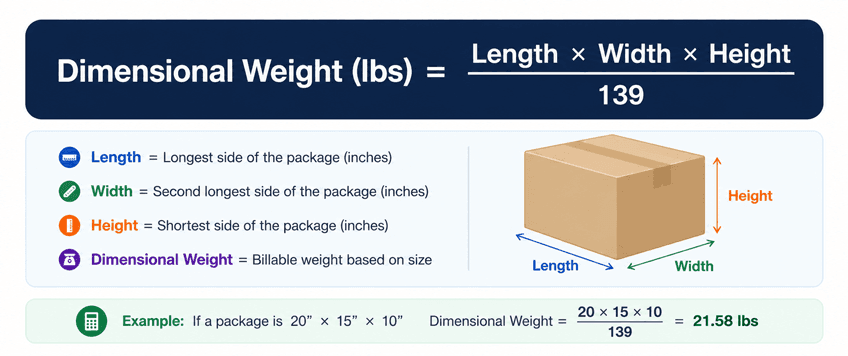
If the resulting DIM weight is higher than the actual physical weight on a scale, FedEx bills you for the higher number. Shipping a lightweight item in an oversized box is the fastest way to overpay.
2. The Trap of Ancillary Surcharges
The base rate is only a fraction of your actual cost. FedEx routinely adds accessorial fees that Shopify’s basic backend fails to anticipate:
- Residential Delivery Charges: Fees applied to drop-offs at home addresses instead of commercial hubs.
- Fuel Surcharges: Weekly fluctuating percentages tied directly to global oil prices.
- Extended Area Surcharges: Additional fees for delivering to rural or less accessible zip codes.
How Expensive Shipping Hurts Shopify Conversion Rates and Revenue
When your shipping operation is inefficient, it creates a negative domino effect across your entire conversion funnel.
If you try to protect your margins by inflating your checkout shipping rates, you trigger immediate cart abandonment. Modern consumers, conditioned by marketplace giants, expect cheap or free shipping.
Conversely, if you offer flat-rate or free shipping without optimizing your actual contract costs behind the scenes, your Average Order Value (AOV) might look healthy, but your net contribution margins will plummet. You are essentially paying to acquire customers only to hand your profits directly over to the carrier.
Recommended Blogs for You:
👉 Which is Better FedEx or UPS: The Definitive Guide for Shopify Merchants (2026)
👉 Private: Why is UPS so Much Better Than FedEx?
👉 eCommerce Fulfillment Services: Scaling Your Shopify Store, Not Your Stress
👉 What Is Dropshipping and How Does It Work?
Step-by-Step Solution: How to Lower Your FedEx Rates on Shopify
Step 1: Secure Pre-Negotiated FedEx Account Rates
Never ship using standard counter rates. Even if you are a mid-sized merchant shipping only 20–30 packages a day, you qualify for FedEx Advantage or tier-based discounts. Contact a dedicated FedEx account executive and provide your past 3 to 6 months of shipping data to negotiate a customized pricing tier.
Step 2: Bridge the Gap with Third-Party Shipping Apps
If your native volume isn’t high enough to command massive corporate discounts, plug your store into Shopify-compatible shipping ecosystems like ShipStation, Shippo, or Planet Shippo. These platforms aggregate the buying power of thousands of merchants to instantly unlock discounted commercial pricing that matches enterprise-level tiers.
Step 3: Implement Live Carrier-Calculated Rates at Checkout
Ensure that your Shopify plan has Carrier-Calculated Shipping (CCS) activated. This feature fetches real-time quotes directly from FedEx at the exact moment of checkout. By displaying accurate, dynamically updated rates to the customer—including exact residential surcharges—you avoid losing money on under-calculated shipping fees.
Shopify Checkout ──> Requests Real-Time Quote ──> FedEx API (Applies Your Discounts) ──> Displays Exact Cost to Buyer
Step 4: Master Box-Size Optimization (Plano-Fulfillment)
Configure your Shopify shipping settings to reflect your exact box sizes rather than a single generic default package. If you frequently ship multi-item orders, utilize packaging apps that use algorithms to determine the smallest possible box required for any combination of SKUs, effectively minimizing your DIM weight footprint.
Tools and Software Frameworks That Make FedEx Optimization Easier
You do not have to calculate these variables manually. A strong tech stack can automate the entire optimization workflow:
- Advanced Shipping Rules (Shopify App): Allows you to create complex, conditional logic for your checkout. You can exclude FedEx from certain zones, add precise handling surcharges, or blend carrier rates seamlessly.
- Shippo or ShipStation: Centralizes your multi-carrier strategy, flags address errors before labels are printed (preventing the dreaded $18+ FedEx address correction fee), and automates international customs documentation.
- FedEx Electronic Trade Documents (ETD): An essential tool for international orders. It transmits commercial invoices digitally, preventing cross-border delays and customs storage fees.
Common Shopify Mistakes That Make Shipping Costs Worse
- Using Default Package Dimensions for Everything: If your Shopify settings have a single default box dimension (e.g., $12 \times 12 \times 12\text{ inches}$), Shopify will send those dimensions to the FedEx API for every single order, even if the item fits into a small bubble mailer. This results in inflated real-time quotes that scare away buyers.
- Ignoring FedEx One Rate for Heavy Items: For heavy items traveling short distances, merchants often overlook FedEx One Rate (their flat-rate shipping option). If your product weighs 15 lbs but fits into a standard FedEx-provided box, flat-rate pricing is almost always cheaper than weight-based or DIM-based commercial ground rates.
- Failing to Audit Invoices: Carriers make mistakes. Duplicate charges, incorrect weight classifications, and missed delivery guarantees happen frequently. Merchants who do not use automated auditing software leave money on the table.
Smarter Alternatives: When to Pivot Away from Standard FedEx Options
If domestic or international FedEx ground options remain too costly for specific zones, consider a hybrid fulfillment strategy.
For Low-Weight Domestic Orders
If your products weigh under 1 lb, consider utilizing FedEx Ground Economy (formerly SmartPost). This service uses the FedEx network for long-haul transport but utilizes the local postal service for final-mile delivery, drastically reducing residential surcharges.
For High-Volume Cross-Border Trade
If international duties and taxes are killing your global conversions, integrate a Delivered Duty Paid (DDP) system via apps like Zonos or Shopify Markets Pro. This allows international customers to pay duties upfront at checkout. It cuts down on abandoned international packages, return-to-sender freight costs, and unexpected brokerage fees from FedEx.
What to Do Next in Your Shopify Optimization Journey
- Audit Your Invoices: Download your last 30 days of FedEx invoices and identify how much you are paying in base rates versus surcharges.
- Update Shopify Box Sizes: Measure your top 3 most-used shipping boxes and input their exact dimensions into your Shopify shipping profile settings.
- Activate CCS: Contact Shopify support or update your plan to ensure live carrier-calculated shipping is active.
- Test a Shipping App: Connect a third-party multi-carrier platform to compare your native FedEx rates against aggregated commercial discounts.
Frequently Asked Questions
How does FedEx calculate dimensional weight for Shopify orders?
FedEx multiplies the box dimensions (Length × Width × Height) and divides by a divisor (139 for standard commercial shipping). If this dimensional value is higher than the physical weight, you are billed based on package size.
What is the cheapest way to ship FedEx internationally on Shopify?
The most cost-effective method is using negotiated economy tiers via third-party shipping apps, combined with Electronic Trade Documents (ETD) to avoid customs delays and automated DDP tools to collect duties at checkout.
Can I get discounted FedEx rates directly through Shopify?
Yes, Shopify offers built-in discounts with select carriers through Shopify Shipping, but connecting your own negotiated FedEx account or using third-party apps often unlocks deeper discounts for high-volume stores.
How do I avoid FedEx residential surcharges on Shopify?
You can encourage customers to ship to commercial addresses, use FedEx Ground Economy for lightweight shipments, or adjust your checkout shipping rules to add a minor handling fee that offsets the residential delivery premium.
Conclusion
Reducing your FedEx shipping costs on Shopify isn’t about finding a single magic trick; it is about eliminating marginal inefficiencies. By configuring precise package dimensions, leveraging aggregated app discounts, auditing your weekly invoices, and implementing real-time carrier calculations, you transform fulfillment from a margin drain into a scalable competitive advantage.