

Most Shopify merchants treat product descriptions like an afterthought. They copy and paste manufacturer bullet points, dump a wall of text onto the page, or write a single, uninspired paragraph that says nothing about why a customer should actually buy the item.
This approach costs money in two distinct ways: first, Google ignores pages with thin, unhelpful content, cutting off organic discovery. Second, users who do land on the page abandon their carts because their fundamental questions remain unanswered.
To write Shopify product descriptions that sell, blend buyer-centric benefits with semantic SEO. Define your target audience, highlight clear problem-solving advantages, map out structured product specifications, and integrate primary and secondary keywords naturally to capture both human buyers and search engines.
The reality of modern e-commerce is that your product page is your digital storefront. Without a physical sales associate present to answer questions, handle objections, and alleviate buying anxieties, your copy must do all the heavy lifting. If your descriptions fail to connect emotionally while providing clear, practical data, your traffic will bounce straight back to the search results.
We will highlight a few frameworks, templates, and optimization steps that make this process straightforward for Shopify brands.
Summary
- The Main Benefit: Learn how to write high-converting, SEO-optimized Shopify product descriptions without sounding robotic or repetitive.
- Who It Helps: Shopify merchants, e-commerce marketing managers, and DTC founders looking to scale organic traffic and improve conversion rates.
- What You Walk Away With: Practical copywriting frameworks, step-by-step optimization workflows, and reusable templates designed for real-world products.
- Key Insight: Great product descriptions must balance human-centric conversion copywriting with algorithmic semantic search optimization.
What You Need Before Starting This Shopify Setup Task
Before typing a single sentence inside the Shopify admin panel, you must gather your brand and technical assets. Writing blind leads to generic copy. To build descriptions that convert, prepare the following foundational components:
- A Defined Customer Persona: Know exactly who is buying. Are they tech-savvy early adopters, budget-conscious parents, or design-focused professionals? Your vocabulary and tone depend entirely on this profile.
- The Master Feature-to-Benefit Matrix: List every technical feature of your product (e.g., “made from 100% organic cotton”) and pair it with a direct human benefit (e.g., “feels incredibly soft against sensitive skin and won’t shrink in the wash”).
- A Targeted Keyword Map: Identify your primary target keyword and at least three to five semantically related long-tail phrases. Use SEO tools to find variations that indicate strong transactional intent.
- Technical Specifications and Compliance Data: Gather exact dimensions, materials, care instructions, warranty information, and manufacturing origins. True clarity prevents product returns.
Step-by-Step Instructions to Optimize Your Shopify Product Pages
Follow this repeatable, sequential workflow to write, format, and publish your new product descriptions inside Shopify.
Step 1: Write a Compelling, Benefit-Driven Hook
Start with an attention-grabbing opening line that addresses your target customer’s primary pain point or deepest desire. Avoid generic statements like “This is a great product.” Instead, focus immediately on the transformation.
Step 2: Expand Into a Narrative Body Paragraph
Elaborate on how the product solves the user’s problem. Keep your paragraphs short—no more than three sentences each. Use active verbs and an authentic brand voice to explain what makes this item unique compared to market competitors.
Step 3: Construct a Clean, Scannable Bulleted List
Break down the core technical features and pair them immediately with practical benefits. Online shoppers rarely read every word on a page; they skim. Bullet points give their eyes an easy place to land while scrolling on mobile devices.
Step 4: Add Structured Technical Specifications
Create a dedicated section or dropdown accordion for the granular details. This keeps the main copy clean while ensuring analytical buyers find the precise sizing, materials, compatibility, or ingredients they need to feel confident purchasing.
Step 5: Inject Semantic SEO Keywords and Meta Tags
Review your draft to ensure your primary keyword appears naturally within the first 100 words, one subheading ($H2$ or $H3$), and the body text. Scroll down to the Search engine listing section at the bottom of your Shopify product edit page.
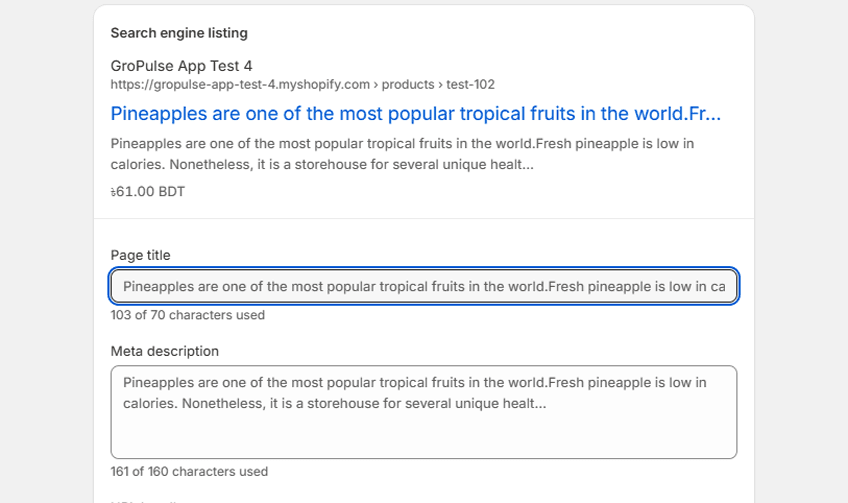
Write a clean URL handle, an enticing meta title under 60 characters, and a clear meta description under 155 characters that includes a strong call to action.
[Shopify Admin] ➔ [Products] ➔ [Select Product] ➔ [Scroll to Search Engine Listing]
Templates, Copy Snippets, and Reusable Layout Blocks
When scaling an e-commerce catalog, starting from a blank page is inefficient. Use these three distinct copywriting frameworks to streamline your writing process.
Framework 1: The PAS Framework (Problem-Agitate-Solve)
This structure works exceptionally well for functional items, problem-solving gadgets, skincare, and utility products.
- The Problem: Define a frustrating issue your customer experiences every day.
- The Agitation: Emotionalize that problem. Why is it annoying? What happens if they don’t fix it?
- The Solution: Present your product as the ultimate, friction-free answer to that specific pain point.
PAS Copy Template:
Tired of tangled headphone cords ruining your morning run? There is nothing worse than stopping mid-stride to unravel a knotted mess when you are trying to beat your personal best. Our Wireless Sport Buds offer seamless Bluetooth connectivity and a secure wrap-around design, letting you focus entirely on your pace, not your pockets.
Framework 2: The AIDA Framework (Attention-Interest-Desire-Action)
Ideal for lifestyle brands, fashion, home decor, and high-ticket luxury products where emotional connection drives conversions.
- Attention: Lead with a bold, striking statement about style, quality, or exclusivity.
- Interest: Hook the buyer with unique details, craftsmanship, or sensory descriptions.
- Desire: Help the customer picture themselves owning the item. How does it elevate their status or lifestyle?
- Action: Provide a clear nudge to choose a variant and add it to their cart.
AIDA Copy Template:
Elevate your workspace with a desk mat designed to last a lifetime. Handcrafted from premium, full-grain vegetable-tanned leather, this minimalist mat develops a rich, personalized patina over years of daily use. Protect your desk from scratches while giving your mouse a perfectly smooth tracking surface. Select your custom size today and upgrade your daily productivity ritual.
Framework 3: The Feature-Benefit Bullet Matrix
Perfect for technical gear, electronics, tools, or complex products that require heavy specification validation.
| Technical Feature | Consumer-Facing Benefit |
| Triple-insulated stainless steel | Keeps your coffee piping hot for up to 12 hours without burning your hands. |
| Reinforced double-stitched seams | Won’t rip, tear, or fray at the gym, saving you from buying replacements next season. |
| IPX7 waterproof rating | Completely safe to use in heavy rain or accidental submersion during outdoor hikes. |
Recommended Blogs for You:
👉 Shopify Sales Funnel Guide: How to Turn Visitors into Customers
👉 How to Integrate Shopify with Amazon
👉 How to Change Shipping from Address on Shopify
👉 Shopify Agentic Storefronts: What Merchants Need to Know
Tools, Frameworks & Templates That Make This Easier
Writing high-converting product descriptions at scale is no longer an entirely manual process. By leveraging Large Language Models (LLMs) and specialized e-commerce apps, you can dramatically accelerate your content output while maintaining a premium editorial standard.
The secret to using AI effectively is simple: Garbage in, garbage out. If you give an AI tool only a generic title, it will return generic fluff. If you feed it specific technical specs, target personas, and keyword constraints, it will produce copy that converts.
1. Foundation Large Language Models (LLMs)
For merchants who prefer absolute control over their prompts, custom brand workflows, and layout structures, direct foundational models provide the highest degree of creative flexibility.
- Claude (Anthropic): Widely regarded by editorial directors as the most naturally human, nuanced writer among foundational AI models. Claude excels at adopting complex brand guidelines without sounding overly salesy or artificial. It is highly recommended for lifestyle, luxury, and DTC brands where tone, pacing, and emotional connection are critical.
- ChatGPT (OpenAI): The most flexible general-purpose tool, particularly when utilizing custom GPTs trained specifically on your product catalog and target audience. ChatGPT is excellent for rapidly applying structural copywriting frameworks like PAS or AIDA to raw data and formatting them directly into ready-to-paste HTML code block grids.
- Gemini (Google): Because it is deeply integrated with Google’s search ecosystem, Gemini is highly effective for semantic SEO research and aligning copy with modern Google AI Overviews. Use Gemini to analyze competitor product copy and extract semantic keyword lists to ensure your copy perfectly satisfies transactional search intent.
2. Native Shopify & Specialized E-Commerce Apps
If you want to generate copy directly inside your store environment without constantly switching browser tabs, use specialized tools designed explicitly for merchant workflows.
- Shopify Magic: The platform’s native, built-in AI assistant. Accessible directly inside your Shopify admin dashboard at no extra cost, Shopify Magic allows you to highlight a product title, input a few key core features, select an overarching tone (such as persuasive, playful, or sophisticated), and generate an instant draft directly inside your product description editor.
- Describely: A dedicated, enterprise-level AI tool built specifically for massive product catalogs and large e-commerce teams. Describely integrates seamlessly with your Shopify catalog via an app, enabling you to manage bulk content generation, execute automated SEO keyword rules, and sync updated copy back to thousands of live SKUs with a single click.
- Writesonic: A highly optimization-focused copywriting app that includes purpose-built templates for online retailers. Writesonic connects directly to live search data, allowing you to generate descriptions that dynamically match the exact real-time keyword density and readability parameters of the top-ranking competitors in your specific niche.
Expert Tips That Make Descriptions Work Better in Real Stores
Writing good copy is only half the battle. To maximize your conversion rate and improve search rankings, implement these advanced, merchant-tested editorial strategies.
Design for Mobile-First Readability
According to mobile commerce trends tracked globally, over 70% of total e-commerce traffic originates from smartphones. On a small screen, a five-sentence paragraph looks like a massive wall of text. Keep paragraphs short, use plenty of white space, and ensure your font sizes remain highly readable without requiring pinch-to-zoom actions.
Speak the Language of Real Customers
Stop using empty corporate buzzwords like “world-class,” “revolutionary,” or “cutting-edge.” They take up valuable space without adding real value. Instead, use the exact phrases your customers write in your reviews or ask your support team. If they praise a blanket for being “cloud-soft,” use that specific phrasing in your description.
Leverage Product Schema for Google AI Overviews
Google’s search engine relies heavily on structured product schema data to display rich snippets, star ratings, stock availability, and pricing in search results. Ensure your Shopify theme is fully compatible with JSON-LD schema, or use a dedicated app to structure your data.
When Google’s AI Overview algorithms analyze your page, they look for structured, factual answers. Writing clear questions and answers within your product descriptions helps ensure your inventory surfaces inside AI-generated response boxes.
How to Troubleshoot Common Shopify Duplicate Content Issues
As your catalog expands, managing unique product text becomes increasingly challenging. Watch out for these technical roadblocks:
- Handling Very Similar Variant Options: If you sell a shirt in ten different colors, do not create ten individual product pages with identical copy. This causes severe keyword cannibalization. Instead, combine them onto a single Shopify product page and use variant swatches.
- Cleaning Up Default Manufacturer Descriptions: Never leave the factory-supplied description intact. Thousands of other drop-shippers and retailers use those exact same strings of text. Google filters out duplicate pages, meaning your store will struggle to rank on the first page of search results.
- Managing Bulk Catalog Updates: If you manage hundreds of SKUs, avoid updating them one by one. Export your catalog via a CSV file, write your copy updates in a structured spreadsheet, and use a bulk editor app to upload your rewrites simultaneously.
Grow Your eCommerce Business with Valuable Resources, Tools, and Lead Magnets
- Bring your ideas to life for $1/month
- One platform that lets you sell wherever your customers are—online
- Create a beautiful eCommerce website
- Start for free, then enjoy $1/month for 3 months
- Build your own website in a few steps
- Create a website in minutes easily, secure method
- Turn what you love into what you sell
- Discover the Shopify Point of Sale
- AI Based Business Name Generator
What to Do Next After Finishing Your Product Description Setup
Once your new descriptions are written and live on your store, your optimization work shifts to monitoring and iterative testing.
First, open Google Search Console and submit your updated product URLs for re-indexing to ensure search engines crawl your fresh keyword additions quickly. Next, establish a baseline for your conversion rates and organic traffic using Shopify Analytics or Google Analytics 4 (GA4).
Let the new copy run for at least 14 to 30 days to collect a statistically significant sample size of traffic. If a page attracts high search impressions but suffers from low conversions, test adjustments to your structural layout, experiment with clearer sizing charts, or reposition your call-to-action buttons to reduce user friction.
Frequently Asked Questions
How long should a Shopify product description be?
Aim for 150 to 300 words. Highly technical, expensive products require longer descriptions to address consumer doubts, while simple, low-cost impulse buys convert well with shorter, punchier text blocks.
Does copying manufacturer descriptions hurt Shopify SEO?
Yes. Copying manufacturer text creates duplicate content issues across search engines. Google prefers unique, high-value editorial content, meaning original copy will consistently outrank copied factory specifications.
Where should I place keywords in my Shopify description?
Integrate your primary target keyword within the first 100 words of your description, inside an $H2$ or $H3$ subheading, and once naturally within your bullet points or concluding summary paragraph.
How do I handle descriptions for items with multiple variants?
Keep them on a single product page and utilize Shopify’s built-in variant options. Write a comprehensive description that covers the shared benefits, and use dynamic theme settings to update specific images or pricing based on the customer’s selection.
Conclusion
Writing effective product descriptions is a balancing act. It requires understanding the exact human motivations that make a buyer click “Add to Cart,” paired with the structured formatting that allows search engine web crawlers to categorize your pages.
By stepping away from generic manufacturer text and building a repeatable system around clear benefits, scannable layouts, and semantic keyword integration, you transform passive browsers into active buyers while scaling your store’s organic reach. Pick five of your top-selling products this week and update their copy using the frameworks above to observe the performance difference firsthand.