


Quick answer: You can add testimonials to Shopify by using a testimonial or Multicolumn section in your theme, creating a dedicated customer-stories page, or installing a testimonial/review app. The best option depends on your theme, how many testimonials you have, and whether you need automated review collection.
Customer testimonials can make a Shopify store feel more trustworthy by showing prospective buyers what existing customers think about your products or brand. But there’s no single universal “Add Testimonials” option across every Shopify theme.
Knowing how to add testimonials to Shopify starts with understanding that, depending on your theme and needs, you can use an existing theme section, create a dedicated customer-stories page, or install a testimonial/review app.
In this guide, we’ll walk through all three methods for how to add testimonials to Shopify, explain when each one makes sense, and also cover Shopify’s current Shop product review system, testimonial placement, collection, design, and common mistakes to avoid.

Bring your ideas to life for $1/month
The future of business is yours to shape. Sign up for a free trial and enjoy 3 months of Shopify for $1/month on select plans.
Testimonials vs. Product Reviews
These two are often confused, so here’s the distinction before diving into how to add testimonials to Shopify using each method.
| Testimonials | Product Reviews |
|---|---|
| Usually curated by the merchant | Usually customer-submitted |
| Brand or service focused | Product focused |
| Shown on homepage, About page, or landing pages | Shown on individual product pages |
| Often added manually | Often collected automatically |
| Quotes, photos, or videos | Ratings, comments, media |
This guide focuses on curated testimonials. Shopify’s native Shop product reviews (covered below) are a separate, related system.
Which Method Should You Use to Add Testimonials to Shopify?
| Method | Best For | Cost | Difficulty | Automatic Collection |
|---|
| Method | Best For | Cost | Difficulty | Automatic Collection |
|---|---|---|---|---|
| Theme section | 3–8 curated testimonials | No additional app cost | Easy | No |
| Dedicated page | Longer customer stories | No additional app cost | Easy | No |
| Review/testimonial app | Growing stores needing volume | Free or paid, depending on app | Easy–medium | Yes |
| Custom block/code | Unique design needs | Development cost/time may apply | Medium–advanced | No |
Our Recommendation at a Glance
- Use your theme if you only need a few hand-picked customer quotes.
- Use a dedicated page if you have longer success stories to tell.
- Use an app if you need automated review requests or plan to display many testimonials.
- Use custom development or Shopify’s AI block generator if you need a unique layout your theme doesn’t offer.
Recommended Blog for You:
👉 How to Use Tags in Shopify: A Step-by-Step Guide
👉 How to Reduce Bounce Rate on Shopify Store
👉 10 Best Shopify Clothing Stores
👉 Shopify Jewelry Stores
👉 Shopify Stores Themes
Grow Your eCommerce Business with Valuable Resources, Tools, and Lead Magnets
- Bring your ideas to life for $1/month
- One platform that lets you sell wherever your customers are—online
- Create a beautiful eCommerce website
- Start for free, then enjoy $1/month for 3 months
- Build your own website in a few steps
- Create a website in minutes easily, secure method
- Turn what you love into what you sell
- Discover the Shopify Point of Sale
- AI Based Business Name Generator
Method 1: Add Testimonials to Shopify With Your Theme
Many Shopify themes provide sections such as Multicolumn, Rich text, or a theme-specific testimonial section that can be adapted for customer testimonials. The exact sections and blocks available depend on your theme and version.

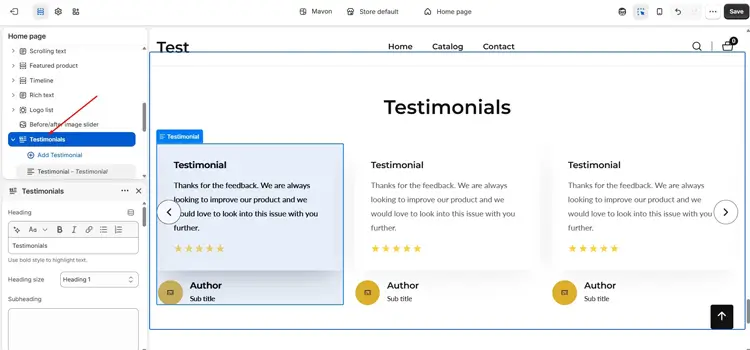
For example, in the Mavon theme, the Home page editor includes a dedicated Testimonials section where you add each quote as an individual “Testimonial” block, with fields for the customer’s name, quote text, and a star rating displayed in a slider layout, as shown below. (Tested on: Mavon theme, August 2026.)
Steps:
- Go to Online Store > Themes > Customize.
- Select the page you want (Home, About, or a custom page), then click Add section.
- Search for a suitable section such as Testimonials, Multicolumn, Rich text, or another text-and-image section; the exact names depend on your theme.
- Click Add Testimonial (or Add block) to create each entry: enter the customer’s name, quote, and optionally a photo or star rating.
- Click Save.
If you’re using a premium theme and want to compare it against alternatives before committing to a layout, it can help to review Shopify themes built for conversion first.
What If Your Theme Doesn’t Have a Testimonial Section?
Your theme may not include one. In that case, you can: use a flexible text/image section instead, generate a custom block using Shopify’s AI block tools, edit theme code, or use a testimonial app. If you’re unfamiliar with how sections and blocks work together on a page, it’s worth reading up on how to add sections to pages in Shopify before making changes.
Alternative: Generate a Testimonial Block With Shopify Magic
Shopify’s theme editor can generate custom theme blocks from a text prompt using Shopify Magic. Shopify’s own documentation gives a testimonial-style block, with a customer photo, quote, name, and star rating as an example use case.
If the Generate option is available in your theme editor, you can describe the testimonial block you want and let Shopify Magic generate it. This feature generates Liquid code for the custom block, so preview the output carefully on desktop and mobile before publishing.
Method 2: Create a Dedicated Testimonials Page
A second way to add testimonials to Shopify is a standalone page, which works better for longer customer stories that don’t fit a compact theme section.

- Go to Online Store > Pages > Add page, title it “Testimonials” or “Customer Stories,” and add your content.
- Add a meta description in the Search engine listing preview field for SEO.
- Click Save.
- Open the Theme Editor, use the page selector at the top to choose your Testimonials page or its assigned page template, and then add the available sections (Multicolumn, Rich text, or a generated block) rather than relying on the plain page editor alone.
- Add the page to your main navigation (Online Store > Navigation).
Pairing the page with theme sections avoids the common mistake of publishing a plain, unstyled block of text. If you’d like the page to also carry more SEO weight, pair this step with the guidance in how to add an FAQ page on Shopify, since FAQ-style sections often sit well alongside testimonials.
Method 3: Use a Shopify Testimonial or Review App
The third way to add testimonials to Shopify is through a dedicated app, which is best for automated collection at scale. This guide doesn’t rank specific apps because pricing, feature limits, and integrations change frequently — compare current Shopify App Store listings based on automated review requests, photo/video support, display widgets, integrations, and pricing before choosing.
One SEO note: Installing a review app doesn't guarantee star ratings in Google Search. Google only shows review snippets for eligible content with valid structured data, and even valid markup doesn't guarantee a rich result. If schema and rich results matter to your store, it’s worth reading how to add schema markup on Shopify alongside this guide.
What About Shopify’s Built-In Shop Product Reviews?
Beyond the three core methods above, Shopify also offers Shop product reviews, managed separately from the theme. By default, customers can review products they purchase either through the Shop app or through your online store — merchants can turn off reviews on purchases made outside Shop if they only want Shop-app reviews. Reviews are star ratings with written comments, and merchants manage and reply to them from Sales Channels > Shop > Reviews.
These are product reviews, not curated brand testimonials, so treat this as a related option rather than a replacement for a homepage testimonial section. If you’re also collecting reviews from other sources, you may find it useful to look at importing reviews from AliExpress to Shopify for a comparison of collection approaches.
Where Should You Place Testimonials?
Focus on homepage, product, landing, and About pages. Shopify doesn’t support normal theme-section customization on checkout and gift-card pages.
| Location | Best Testimonial Type |
|---|---|
| Homepage | Brand-wide customer satisfaction |
| Product page | Product-specific experience |
| Landing page | Testimonials related to that specific offer |
| About page | Brand and customer relationship stories |
| Customer Stories page | Longer testimonials or case studies |
What Makes a Good Testimonial
A strong testimonial includes the customer’s name, a specific detail about their experience, and — with permission — a photo.
Weak testimonial: “Great store. Highly recommended!”
Better testimonial: “The size guide helped me order the right fit on the first try, and my jacket arrived two days earlier than expected.” — Sarah M.
Keep testimonials authentic and specific; avoid editing feedback in a way that changes its meaning, and don’t manufacture an unrealistically perfect set of quotes. Only display star ratings next to testimonials when they reflect genuine ratings collected in a trustworthy way — otherwise readers may mistake a curated quote for a verified review.
How to Collect Testimonials
Ask customers for feedback after purchase via a follow-up email. If you offer an incentive for feedback, don’t condition it on receiving a positive review, disclose the incentive where required, and follow Shopify’s and your review platform’s current rules for that platform.
Design and Accessibility Best Practices
- Grid vs. slider: grids let visitors scan all testimonials at once; sliders save space but can hide content and need accessible, working controls on mobile.
- Add meaningful alt text to customer photos.
- Don’t rely on an image of text as the only readable version of a testimonial.
- Maintain sufficient text contrast and keep slider controls keyboard-accessible.
- Avoid auto-advancing sliders too quickly for users to read.
- Make carousel navigation controls clearly labeled for screen-reader users.
Common Mistakes to Avoid When You Add Testimonials to Shopify
- Assuming every theme has a “Testimonials” section by default — check your specific theme first.
- Treating Shop product reviews as identical to curated testimonials.
- Displaying star icons next to testimonials that aren’t genuine, verified ratings.
- Offering incentives that are conditional on a positive review.
- Adding testimonials as plain, unstyled text on a dedicated page instead of using sections.
- Publishing fabricated testimonials or presenting AI-generated quotes as real customer feedback.
- Using vague quotes such as “Amazing!” that don’t describe an actual customer experience.
Frequently Asked Questions
Can I add testimonials to Shopify without an app?
Yes. You can add testimonials without an app if your theme provides a suitable section or if you create a dedicated page or custom block.
What if my Shopify theme doesn’t have a testimonial section?
Use a flexible text/image section as a substitute, generate a custom block with Shopify Magic, edit theme code, or install a testimonial app.
Does Shopify have a built-in review feature?
Yes — Shop product reviews, which are separate from theme-level testimonials and cover products bought via the Shop app or your online store.
Can testimonials include customer photos or videos?
Yes. Photos can usually be added through compatible theme sections or apps. For video testimonials, you can use a compatible theme or video section, an embed, custom development, or an app that supports video reviews.
How many testimonials should I show on my homepage?
There’s no universal ideal number. Start with a small set of your strongest, most relevant testimonials and add more only when they help users make a decision rather than making the page feel repetitive. For a compact homepage section, many stores start with 3–6 testimonials because they’re easy to scan without dominating the page.
Should I get permission before publishing a customer’s testimonial?
Yes — keep written permission covering what you can publish, especially when using a full name, company, photo, or measurable results.
Final Thoughts: How to Add Testimonials to Shopify
Adding testimonials to Shopify doesn’t always require another app. If your theme already provides a suitable section, that’s usually the simplest option for a small collection of customer quotes.
A dedicated customer-stories page works better for longer stories, while a testimonial or review app makes more sense when you need automated collection and larger volumes of feedback.
Whichever method you choose to add testimonials to Shopify, focus on authentic, specific testimonials and place them where they support an actual buying decision. Make sure customer names, photos, ratings, and claims are used accurately and with appropriate permission.
If your store is still struggling to convert visitors despite adding social proof, it may be worth reviewing broader guidance on why your Shopify store isn’t making sales.
Need a Custom Testimonial Section?
If your theme doesn’t support the layout you want, ShopiBuffet can help you create or customize a Shopify testimonial section that matches the rest of your storefront.
What Services We Offer:
- Theme Installation & Demo Setup
- Product & Collection Setup
- Navigation Setup
- Shopify SEO Services
- Shopify migration service
- Shopify stores regular updates and maintenance service