

Adding a popup to your Shopify store is one of the simplest ways to grow your email list, promote offers, and recover abandoned visitors without redesigning your whole storefront. This guide shows you how to add a popup on Shopify using either a popup app or the Mavon Shopify theme, plus how to make your popup helpful, mobile-friendly, and conversion-focused.
Quick Answer: You can add a popup on Shopify in two common ways: install a popup app from the Shopify App Store, or use your theme’s built-in popup settings if your theme supports it. If you use the Mavon Shopify theme, you can enable and customize a built-in popup directly from the theme editor, including delay time, position, display rules, and repeat behavior.

Bring your ideas to life for $1/month
The future of business is yours to shape. Sign up for a free trial and enjoy 3 months of Shopify for $1/month on select plans.
What is a Popup?
A popup is a small message box that appears over your storefront to encourage visitors to take action. Shopify merchants usually use popups to collect email subscribers, promote discounts, announce important updates, or recover visitors before they leave the site.

Why Add a Popup to Your Shopify Store?
A well-designed popup can help you:
- Grow your email list with newsletter signups or first-order discounts.
- Promote seasonal offers, bundle deals, or free shipping campaigns.
- Recover leaving visitors with exit-style offers.
- Highlight new arrivals, limited stock, or bestselling products.
- Drive attention to an important landing page, product, or collection.
Popups work best when they appear at the right time, offer something useful, and are easy to close on both desktop and mobile. If your store also feels heavy or slow, review this guide on Shopify page speed optimization before adding too many scripts or media-heavy designs.
Recommended Blog for You:
👉 A Comprehensive Guide on How to Change Favicon on Shopify
👉 How to Edit Mobile View on Shopify: Creating a Mobile-Friendly User Experience
👉 How to Change Background Color on Shopify – A Step by Step Guide
👉 What Does Shopify Cost? The Ultimate Guide to Shopify Pricing and Features
Common Types of Shopify Popups
There are several types of pop-up available. Some of them are given below:
- Regular popup: A regular popup usually appears in the center of the screen. It works well for welcome discounts, email signup forms, and storewide promotions.
- Slide-in popup: A slide-in appears from the side or bottom of the screen. It is less intrusive than a center popup and can work well for product recommendations or content promotions.
- Sticky bar popup: A sticky bar stays at the top or bottom of the page while a visitor scrolls. It is useful for free shipping messages, limited-time deals, or coupon reminders.
- Exit-intent popup: An exit-intent popup appears when a desktop visitor is about to leave the page. It is often used to reduce cart abandonment or capture an email before the visitor leaves.
- Multi-step popup: A multi-step popup asks for information in stages, such as email first and preferences second. This can feel easier to complete than showing every field at once.
Grow Your eCommerce Business with Valuable Resources, Tools, and Lead Magnets
- Bring your ideas to life for $1/month
- One platform that lets you sell wherever your customers are—online
- Create a beautiful eCommerce website
- Start for free, then enjoy $1/month for 3 months
- Build your own website in a few steps
- Create a website in minutes easily, secure method
- Turn what you love into what you sell
- Discover the Shopify Point of Sale
- AI Based Business Name Generator
How to Add a Popup on Shopify: Two Main Ways
There are two practical ways to add a popup on Shopify:
- Use a popup app from the Shopify App Store.
- Use built-in popup settings in a theme that supports it, such as the Mavon Shopify theme.
If you are still learning how theme customization works, this beginner guide on how to customize a Shopify theme can help before you start editing popup settings.
Method 1: Add a popup using a Shopify popup app
Using an app is the most flexible option for most Shopify stores because it works across many themes and usually offers more targeting and analytics.
Step 1: Open the Shopify App Store
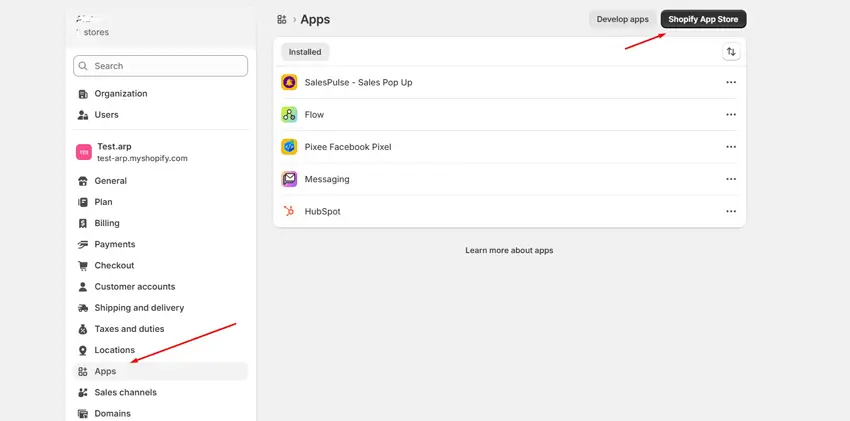
From your Shopify admin:
- Go to Apps.
- Click Shopify App Store.
- Search for terms like popup, newsletter popup, or email popup.
Choose an app that matches your goal, such as collecting emails, promoting a discount, or showing exit-intent offers.
Step 2: Install the popup app
Open the app listing, review its features, and install it on your store. After installation, follow the setup instructions inside the app dashboard.
Step 3: Create a popup campaign
Most popup apps let you choose the popup type and template first. Start with one clear goal, such as:
- Get 10% off your first order.
- Join our email list for updates.
- Get notified about new arrivals.
- Claim free shipping today.
Step 4: Customize your popup design
Edit the main elements of the popup:
- Headline
- Supporting text
- Image or product visual
- Email field or button
- CTA button text
- Colors and fonts
Keep your design consistent with your store branding.
If you need to align popup styling with your storefront design, this tutorial on how to change background color on Shopify can help with broader theme color adjustments.
Step 5: Set popup triggers and targeting
Most apps let you control when the popup appears. Common trigger options include:
- After a few seconds on the page
- After scrolling a certain percentage
- On exit intent
- On specific pages only
You may also be able to target new visitors, returning visitors, or users on certain product and collection pages.
Step 6: Preview and test the popup
Before publishing:
- Test the popup on desktop.
- Test the popup on mobile.
- Make sure it is easy to close.
- Check that forms, buttons, and discount codes work properly.
Since popup performance depends heavily on mobile UX, it is smart to also check your layout using this guide on how to edit mobile view on Shopify.
Step 7: Publish the popup
Once everything looks good, publish or enable the popup inside the app. Then monitor results such as email signups, click-through rate, and conversions.
Method 2: Add a popup using the Mavon Shopify theme
If you are using the Mavon Shopify theme, you can create a popup directly from the built-in theme settings without needing a separate popup app.
Step 1: Open the Mavon theme editor
- Log in to your Shopify admin.
- Go to Online Store → Themes.
- Find your Mavon theme.
- Click Customize.
Step 2: Open the popup settings
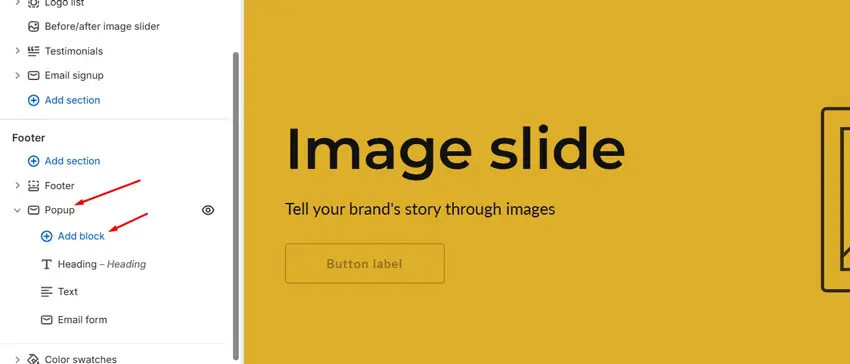
Inside the Mavon theme editor, open the Popup settings area. This is where you can control the popup design, display rules, and behavior.
Step 3: Choose the display mode
Mavon includes a Display mode setting with three practical options:
- Enable: Shows the popup on your live store.
- Disable: Turns the popup off.
- Testing: Lets you preview the popup while adjusting settings before publishing.
Start with Testing mode so you can safely review the popup design and behavior before making it live.
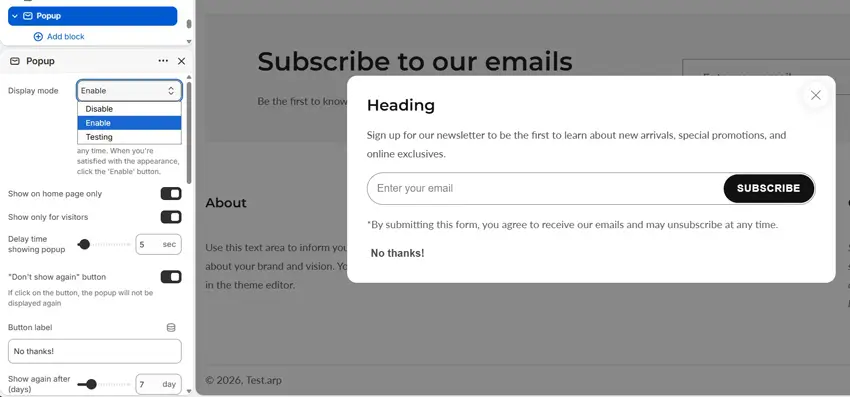
Step 4: Control where the popup appears
Mavon gives you display control options such as:
- Show on homepage only if you only want the popup on your main landing page.
- Show only for visitors if you want to avoid showing the popup to logged-in customers.
These controls are useful when you want to focus on first-time visitors without interrupting returning customers.
Step 5: Set timing and repeat behavior
To improve user experience, configure timing carefully:
- Delay time showing popup: Choose when the popup appears after page load.
- Don’t show again: Lets the visitor dismiss the popup.
- Show again after X days: Controls how soon the popup can reappear.
These settings help reduce annoyance and make the popup feel more intentional.
Step 6: Adjust width and position
Mavon allows you to control the popup layout more precisely:
- Popup width: Small, medium, or large.
- Position: Center, bottom right, or bottom left.
A centered popup is usually best for email capture, while a corner popup may feel lighter and less disruptive.
Step 7: Add image and background styling
Mavon also includes visual settings such as:
- Desktop image
- Image position left or right
- Full-width background image option
- Overlay opacity
Use these settings carefully so the popup remains readable and not overly busy.
Step 8: Customize colors and buttons
Update the popup so it matches your store branding:
- Background color
- Text color
- Button background color
- Button text color
- Hover colors
Use strong contrast between your background and CTA button so the action stays clear.
Step 9: Add your popup content
Write simple, benefit-focused copy such as:
- Headline: Get 10% Off Your First Order
- Text: Join our email list for exclusive offers and product updates.
- Button: Get My Discount
Keep the wording short and useful. One clear offer usually performs better than trying to say too much.
If you are still confused, read more from the documentation on how to create Popup using Mavon
Step 10: Save, test, and publish
After configuring the popup:
- Save your changes.
- Preview the popup in testing mode.
- Test on mobile and desktop.
- Confirm the popup appears at the right time and is easy to close.
- Switch from Testing to Enable when you are ready.
If your popup links to products with low stock, you can also use visual urgency better by learning how to put sold out on Shopify for unavailable items.
Video Presentation
Best practices for a high-converting Shopify popup
- Offer one clear benefit: A popup should answer one question quickly: why should the visitor care? A welcome discount, free shipping, exclusive access, or useful update usually works better than a generic “subscribe now” message.
- Do not show it too early: If the popup appears immediately, visitors may close it before they understand your store. Waiting a few seconds or using scroll-based timing often creates a better experience.
- Keep the design simple: Avoid too much text, too many colors, or too many buttons. The visitor should instantly understand the offer and what to do next.
- Make it easy to close: A popup that is hard to close can frustrate users, especially on mobile. Clear close controls improve trust and reduce bounce risk.
- Test on mobile first: Many Shopify visitors shop from mobile devices. A popup that looks great on desktop may feel broken or intrusive on mobile, so always preview it carefully.
- Track results and improve: After the popup goes live, monitor:
- Email signups
- Click-through rate
- Conversion rate
- Discount code usage
- Bounce behavior
Then test better offers, different timing, or simpler layouts.
🚀 Ready to skyrocket your Shopify store to success?
🚀 Unlock the secrets to success and boost your sales 📈 with ShopiBuffet’s expert services. Don’t miss out, get started now!
Should you use a pop-up app or Mavon pop-up settings?
| Option | Best for | Main advantage | Main limitation |
|---|---|---|---|
| Popup app | Stores that want advanced targeting and app-based features | More flexibility and often more analytics | Extra app dependency |
| Mavon built-in popup | Stores using Mavon and wanting a fast native setup | No separate popup app needed | Limited to the theme’s built-in feature set |
🚀 Boost Your Online Store Sales with Mavon Shopify Theme!
Try Mavon for Free Today!
Frequently Ask Questions
Does Shopify have a built-in popup?
Shopify itself does not provide a universal popup builder for all stores, but some themes include built-in popup settings and many popup apps are available through the Shopify App Store.
Is a popup good for Shopify?
Yes, a popup can work well if it offers real value, appears at the right time, and is easy to dismiss. A poor popup experience can annoy visitors, so setup matters.
What is the best popup for Shopify?
The best popup depends on your goal. For email list growth, a welcome or newsletter popup works well. For cart recovery, an exit-style popup or limited-time offer can be more effective.
Should I use a popup on mobile?
Yes, but it needs to be lightweight, readable, and easy to close. Always preview the mobile version before publishing.
Conclusion
If you want the easiest path for advanced popup targeting, a Shopify popup app is usually the better option. If you use the Mavon Shopify theme and want a clean built-in solution, the native popup settings are a strong starting point.
The most important thing is not just adding a popup, but making it useful, well-timed, and easy to use on mobile. A focused popup can support email growth, promotion visibility, and conversion goals without harming the shopping experience.