

Choosing where to build your digital storefront is the single most important operational decision you will make this year. If you are evaluating Shopify vs Teespring (now known globally as Spring), you are looking at two entirely fundamentally different business models.
One is an all-inclusive marketplace designed to let you upload designs and start selling in minutes; the other is a robust infrastructure tool built to help you scale a fully independent global brand.
Quick Answer: The Core Tradeoff
Choose Spring if you want zero upfront costs, zero inventory management, and want to sell custom merchandise directly to an existing social media audience. Choose Shopify if you want to build a long-term, scalable asset, own your customer data, use custom domains smoothly, and have total control over your conversion optimization and branding.
Understanding the Foundations: Marketplace vs Infrastructure
To pick the correct tool, you must understand exactly what these systems were engineered to do.
STRUCTURAL DIFFERENCE
SPRING (TEESPRING)
- Managed Print-On-Demand
- Shared Marketplace Traffic
- No Monthly Subscription Base
SHOPIFY
- Independent E-commerce SaaS
- Total Brand Autonomy
- Premium App Ecosystem
What is Spring (Formerly Teespring)?
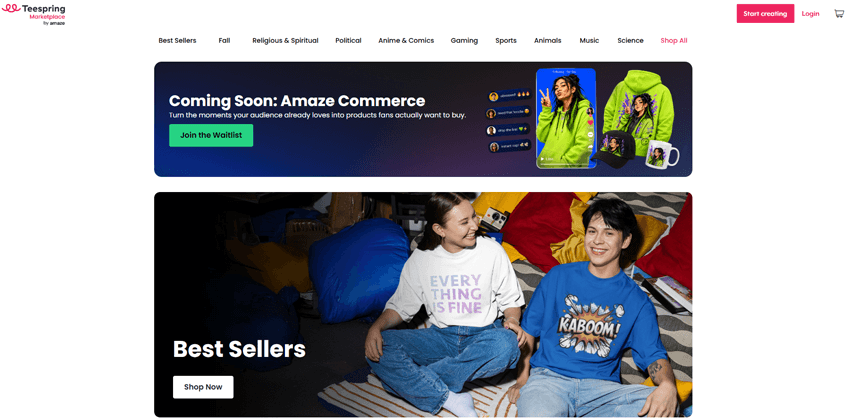
Spring is a managed Print-on-Demand (POD) platform. When you open a storefront on Spring, you do not build an independent website. Instead, you create a profile inside their existing digital ecosystem. You design products using their digital mockup generator, and when a consumer purchases an item, Spring prints, packs, ships, and handles customer service on your behalf. You do not buy raw inventory; you simply earn a profit margin on each sale.
What is Shopify?
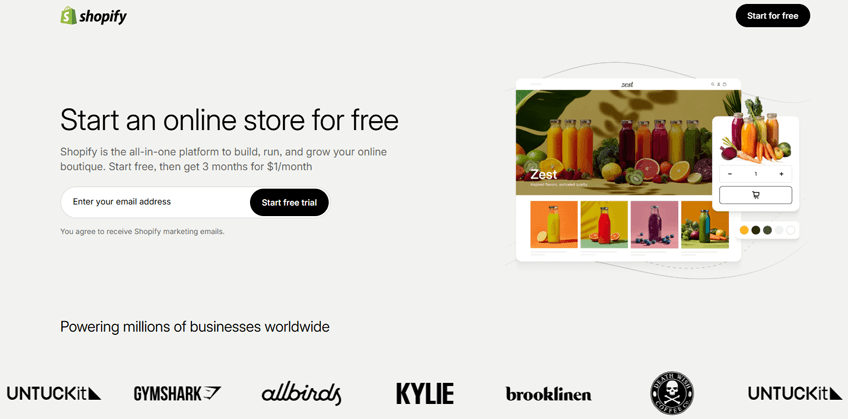
Shopify is an enterprise-grade e-commerce platform software-as-a-service (SaaS). Shopify does not manufacture products, hold stock, or print designs. Instead, it provides the digital infrastructure—the checkout funnel, domain hosting, design templates, and payment processing engines—needed to run an online retail store. To do print-on-demand on Shopify, you simply pair your store with third-party supply chain apps like Printful, Printify, or Gelato via the Shopify App Store.

Bring your ideas to life for $1/month
The future of business is yours to shape. Sign up for a free trial and enjoy 3 months of Shopify for $1/month on select plans.
Detailed Feature Breakdown
1. Storefront Setup and Ownership
Setting up a Spring store takes less than ten minutes. You hit the “Start Designing” portal, register an account, upload a transparent graphic asset, place it on an item vector, and push the listing live. The storefront runs on a sub-domain framework under Spring’s umbrella.
On Shopify, setup requires more intentional brand assembly. You connect a custom top-level domain (yourbrand.com), configure explicit payment gateway routing, establish standard shipping zones, and select an organizational theme. While it demands more initial configuration, you maintain absolute asset ownership. If you decide to transition your business later, you own your customer data records and your domain equity—things Spring retains on its database.
2. Design Customization, Themes, and App Extensions
Design parameters illustrate the starkest contrast between these two platforms:
- Spring Customization: Your digital footprint is strictly bound to Spring’s layout framework. You can add brand logos, basic header banners, and write text bios, but the fundamental product display blocks and checkout flows are fixed.
- Shopify Customization: Shopify gives you open access to liquid code architectures and underlying CSS styling scripts. Through the Shopify Theme Store, you can deploy deeply optimized, high-converting premium themes that match your precise aesthetic requirements.
Conversion Note: A major pitfall for growing merchants on Spring is conversion friction. Because you cannot modify the checkout steps, upsell layouts, or site speed elements, you are stuck with their structural baseline performance. Shopify allows you to deploy custom countdown triggers, cart page cross-sells, and tailored review structures that directly boost Average Order Value (AOV).
Financial Breakdown: Subscriptions vs. Production Base Costs
The underlying fee mechanics of these platforms impact your cash flow and net profitability differently.
Spring (Teespring)
- Monthly Subscription Fee: $0 / Month
- Transaction/Gateway Fees: Included in base item cost
- Upfront Inventory Costs: $0 (Products made after customer order)
- Profit Margin Structure: You keep the delta:
(Your Price) - (Spring Base Cost) - Custom Domain Fees: Optional upgrade through Spring
Shopify
- Monthly Subscription Fee: Basic: $29-$39/mo (Variable based on billing cycle promotions)
- Transaction/Gateway Fees: 0% if using Shopify Payments (otherwise 0.5% – 2.0%)
- Upfront Inventory Costs: $0 if paired with POD apps; variable if self-sourcing
- Profit Margin Structure: You keep the delta:
(Your Price) - (SaaS + App Production Costs) - Custom Domain Fees: Required (approx. $14/year)
On Spring, if a custom hooded sweatshirt features a fixed production cost base of $22, and you list it for retail at $45, your net profit margin payout is exactly $23. If your storefront generates zero transactions over three months, your maintenance cost is $0.
On Shopify, you pay a recurrent monthly SaaS subscription fee to keep your digital doors open, plus any premium application extension monthly renewals. However, because you retain open access to negotiate with any wholesale print provider across the globe via app integrations, your base production costs are frequently significantly lower than Spring’s static marketplace pricing. At scale, those lower product base costs quickly offset the fixed monthly subscription fee.
Recommended Blogs for You:
Shopify vs Wix: Which eCommerce Platform Is Best For Your Business?
Shopify vs WooCommerce (2026): Which eCommerce Platform Is Best for Your Store?
Fulfillment, Logistics, and Global Supply Chains
Operational reliability dictates whether a customer leaves a positive review or files a payment chargeback.
The Spring Ecosystem Fulfillment Chain
Spring operates a completely centralized production loop. When a customer places an order, it is automatically routed to one of Spring’s vetted print facilities. This eliminates tracking link management errors, but it strips away your input flexibility. If a specific printing facility encounters material stock delays or holiday shipping backlogs, your customers face wait times, and you have zero capacity to reroute production orders to alternative regional providers.
The Shopify Ecosystem Fulfillment Chain
Shopify acts as a decoupled command hub. By linking specialized print-on-demand applications to your backend dashboard, you control exactly which facilities execute your production run. If an item sells out at a domestic printer, you can instantly route the order to an international facility with available inventory with a single click.
Marketing and Customer Data Retention
SPRING
- Relies on “Boosted Network
- No Direct Customer Email Lists
- Limited Organic SEO Reach
SHOPIFY
- Direct Pixel Integration
- Advanced Email Flows
- Full Technical SEO Root
With Spring, you leverage their organic search algorithms and access their “Boosted Network” feature, which can syndicate your designs across massive global marketplaces like Amazon or eBay in exchange for an extra processing fee split. Additionally, Spring features strong, direct API store shelf modules built right into platforms like YouTube, Twitch, and TikTok profiles.
The downside? You do not own your customer analytics data. Spring does not hand over consumer email addresses or allow deep pixel tracking deployment for ad retargeting. This means you cannot run automated post-purchase email flows, win-back sequence campaigns, or lookalike audience building profiles.
With Shopify, you are fully responsible for driving every single visitor to your store via search engine optimization (SEO), paid search engine marketing, or organic social media loops. However, you retain 100% data transparency. You own every email lead, cart abandonment profile, and complete transaction history log. This lets you construct durable marketing assets that steadily compound in brand value over time.
Navigating the Deprecated Shopify-Teespring Integration
A common source of confusion among digital merchants stems from old search results regarding a direct, native Shopify-Teespring integration application.
Technical Clarification: The legacy, native direct integration app developed between Shopify and Teespring is officially deprecated. You can no longer link a Spring marketplace account straight into a Shopify store dashboard through a simple one-click native plugin.
If your strategic goal is to harness Shopify’s high-converting storefront themes while utilizing an automated print-on-demand fulfillment framework, you should select a modern, actively supported alternative from the Shopify App ecosystem:
- Printful: Offers deep optimization for retail clothing lines, offering complex embroidery, custom product tag branding, and dependable global fulfillment facilities.
- Printify: Connects you to an open network of global printing providers, allowing you to select manufacturers based on real-time fulfillment speed ratings, geographic proximity, and baseline product cost.
- Gelato: Highly optimized for localized global printing, which dramatically reduces international cross-border shipping delays and carbon footprint footprints.
Grow Your eCommerce Business with Valuable Resources, Tools, and Lead Magnets
- Bring your ideas to life for $1/month
- One platform that lets you sell wherever your customers are—online
- Create a beautiful eCommerce website
- Start for free, then enjoy $1/month for 3 months
- Build your own website in a few steps
- Create a website in minutes easily, secure method
- Turn what you love into what you sell
- Discover the Shopify Point of Sale
- AI Based Business Name Generator
Operational Decision Framework: Which Should You Choose?
Choose Spring If:
- You are an active content creator, streamer, or influencer with an engaged audience who wants to launch a casual merchandise line without financial exposure.
- You do not want to manage customer tracking complaints, sales tax compliance returns, or fulfillment logistical errors.
- You do not need a custom brand identity and are satisfied with standard template storefront profiles.
Choose Shopify If:
- You want to launch a standalone e-commerce brand that you could potentially sell or flip down the line.
- You want absolute control over your visual conversion rates, landing page optimizations, and user journey analytics.
- You want to maximize your profit margins by sourcing items from multiple global manufacturing sources.
Frequently Asked Questions
Is Spring (Teespring) completely free to use?
Yes. Spring charges zero monthly subscription costs or upfront listing fees. The platform generates revenue by keeping a base production fee from every custom product you sell, passing the remaining profit margin directly to your dashboard balance.
Can I transition my products from Spring to Shopify later?
You can recreate your graphic designs on Shopify at any time by pairing your new store with an app like Printify or Printful. However, because Spring owns the structural account database, you cannot automatically migrate customer accounts, past transaction logs, or review histories over to your new platform.
Do I need a business license to sell items on Shopify?
Shopify does not require an active business license to set up a testing storefront account. However, depending on your local state, country, or municipality regulations, you will ultimately need a registered business entity to handle legal tax collection thresholds once your payment gateways process consistent sales volumes.
Who handles shipping returns and defective products on Spring?
Spring completely manages all end-user customer support requests, product exchange logistics, and manufacturing error refunds through their centralized support ticketing desks, meaning you don’t have to handle customer service emails yourself.