

Launching a Shopify store in 2026 is easier than ever, but turning it into a consistently profitable business is still rare.
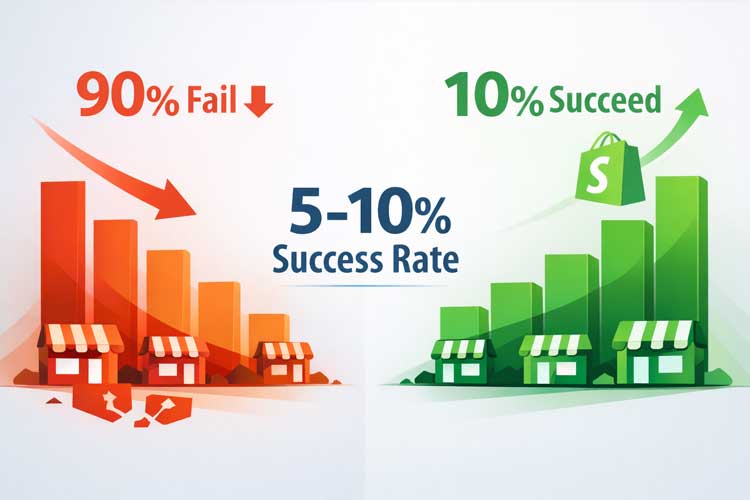
The Shopify success rate tells a sobering yet actionable story: only about 5–10% of Shopify stores become sustainably profitable, while the majority either stagnate or quietly shut down without ever reaching.
Before diving into why most Shopify stores fail, it is essential to define what Shopify success rate actually refers to in practical business terms. meaningful revenue.
However, the good news is that the reasons most Shopify stores fail are repeatable, predictable, and fixable. This means your chances of success go up dramatically when you understand the data and act strategically.
Unlike lottery-based niches, the Shopify success rate can be influenced by your choices, execution, and willingness to learn.
Key Takeaways
- Realistic Shopify success rate in 2026
- Why most new Shopify stores quietly fail
- Core metrics that define a successful store
- Proven strategies to improve Shopify success rate
- How to build a profitable Shopify brand
- Actionable steps to avoid common Shopify pitfalls

Bring your ideas to life for $1/month
The future of business is yours to shape. Sign up for a free trial and enjoy 3 months of Shopify for $1/month on select plans.
What “Shopify Success Rate” Really Means
Before diving into why most Shopify stores fail, it is essential to define what the Shopify success rate actually refers to in practical business terms.
What is Shopify Success Rate?
In this context, Shopify success rate means the percentage of Shopify stores that:
- Generate consistent, reliable revenue that covers all operating costs.
- Maintain healthy profit margins (typically 10–20% net profit) rather than operating at break-even or loss.
- Survive beyond the initial 12–24 months instead of closing or going dormant.
- Have a sustainable customer acquisition cost (CAC) relative to lifetime value (LTV).
Industry analyses and independent Shopify research consistently estimate that only about 5–10% of Shopify merchants reach this level of genuine, long-term profitability.
This inversely means that 90–95% of Shopify stores fail to achieve sustained profitability, though some continue operating at low revenue levels or abandon the business entirely.
How Many Shopify Stores are Successful?
Shopify does not publish an official public “success vs failure” rate, but multiple independent data sources give a realistic picture.
- Shopify powers millions of live stores globally, but over 7 million stores have been created to date, suggesting high churn and a relatively low survival rate.
- Shopify statistics and ecommerce studies consistently estimate that 5–10% of Shopify stores hit genuine, sustainable profitability while the rest remain small or shut down.
So when people ask “how many Shopify stores are successful?”, the honest answer is that a small minority reach true profitability, but those that do often scale to six or seven figures per year.
Shopify Success Rate vs Overall Ecommerce Success
Understanding Shopify success rate in isolation can be misleading. It is more useful to compare it with broader ecommerce and small business trends.
Market-Wide Ecommerce Context
- Global ecommerce growth: Ecommerce is projected to account for over 20% of global retail sales by 2026, with total sales passing the $6 trillion threshold, reflecting strong underlying market opportunity.
- Shopify’s market dominance: Shopify captures 30% of US ecommerce businesses, making it the market-leading platform in North America, and Shopify merchants collectively generate over $1.4 trillion in revenue.
- Global ecommerce platform share: While Shopify leads in the US and UK, globally it holds about 10.56% of ecommerce platform market share, behind WooCommerce (39.05%), but still a significant player in the broader ecosystem.
Why the 5–10% Success Rate Is Normal
Small business statistics show that approximately 45–50% of new businesses fail within five years, largely due to poor planning, insufficient capital, weak demand, and cash flow issues.
From this perspective, Shopify’s 5–10% long-term profitability rate aligns with broader ecommerce and small business realities:
- Success is concentrated: A small group of operators captures most of the results and revenue
- Selection matters: Platform choice affects outcomes, but execution matters far more
- Failure causes are avoidable: Most failures stem from strategy, marketing, and unit economics, not the platform itself.
This means that, unlike a lottery, improving your Shopify success rate is within your control through better planning, marketing, and operations.
Core Metrics Behind Shopify Success
Improving your Shopify success rate starts with understanding the numbers that define whether a Shopify store is successful or not.
1. Conversion Rate: Turning Visitors Into Customers
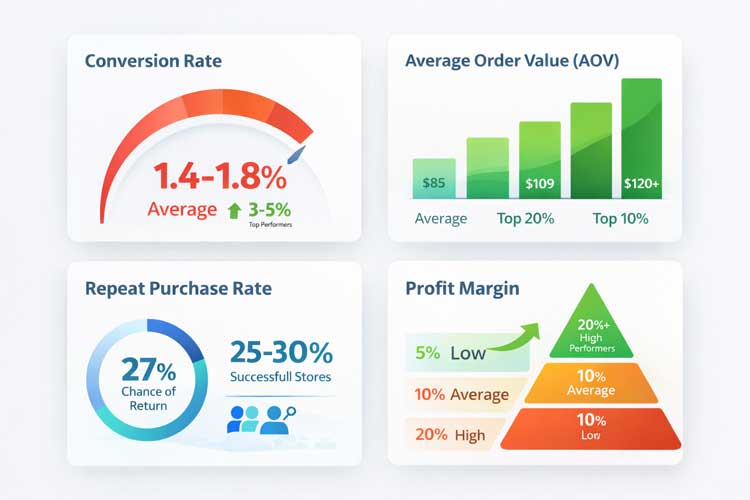
- The average Shopify store conversion rate is around 1.4%, meaning roughly 1–2 visitors out of 100 place an order.
- Top‑performing Shopify stores convert at 3–5% or higher, often thanks to better UX, stronger offers, and clearer positioning.
- Elite stores in the top 10% achieve conversion rates above 4.7%, with some exceptional stores reaching 8% or higher.
Why this matters for your success:
If your conversion rate is consistently below 1%, your Shopify store success rate drops sharply unless you compensate with extremely high average order value (AOV) or exceptional repeat purchase rates.
Conversely, improving conversion rate from 1.4% to even 2.5% can dramatically improve profitability without needing significantly more traffic.
2. Average Order Value (AOV): How Much Each Customer Spends
What the data shows:
- Global Shopify AOV ranges from $85–$92, though this varies significantly by industry, region, and store maturity.
- Top 20% of stores achieve AOV of $109 or higher, while the top 10% exceed $120 per transaction.
- Mobile AOV is typically 40–50% lower than desktop AOV due to different purchasing behavior and device limitations.
Why this matters:
Successful Shopify stores use bundles, upsells, cross-sells, and tiered pricing to increase AOV. Even a modest $10 increase in AOV from $85 to $95 can improve annual profit by 10–15% without requiring more traffic.
High-AOV stores are also more resilient to rising ad costs and can afford higher customer acquisition costs (CAC) while remaining profitable.
3. Repeat Customers and Lifetime Value (LTV)
What the data shows:
- A customer has roughly a 27% chance of returning to a Shopify store after their first purchase.
- Repeat customers spend approximately 67% more than first-time buyers.
- Successful Shopify brands often report repeat purchase rates of 25–30%, meaning 1 in 4 customers buys again.
Why this matters:
Building high LTV is crucial for sustainable Shopify success rate because:
- Repeat customers cost 50% less to acquire than new customers
- They generate predictable revenue independent of paid ad spend
- They enable higher-margin, brand-focused strategies rather than pure volume plays
Stores that ignore retention and chase only new customer acquisition tend to have lower long-term success rates.
4. Profit Margins: The Bottom Line
What the data shows:
- The average net profit margin for Shopify stores is estimated at around 10%.
- Low-end profit margin: 5% (considered the floor for sustainability)
- Average profit margin: 10%
- High-end profit margin: 20%+ (typical of branded, high-margin stores)
- Gross profit margins for small ecommerce stores average 30%, while larger businesses achieve 37%. The optimal gross margin target is around 40%.
Why this matters:
Many Shopify stores fail because they prioritize revenue growth over profitability. A $100,000/month store with 3% net margins ($3,000 profit) is less successful than a $20,000/month store with 20% margins ($4,000 profit).
Grow Your eCommerce Business with Valuable Resources, Tools, and Lead Magnets
- Bring your ideas to life for $1/month
- One platform that lets you sell wherever your customers are—online
- Create a beautiful eCommerce website
- Start for free, then enjoy $1/month for 3 months
- Build your own website in a few steps
- Create a website in minutes easily, secure method
- Turn what you love into what you sell
- Discover the Shopify Point of Sale
- AI Based Business Name Generator
Why Most Shopify Stores Fail
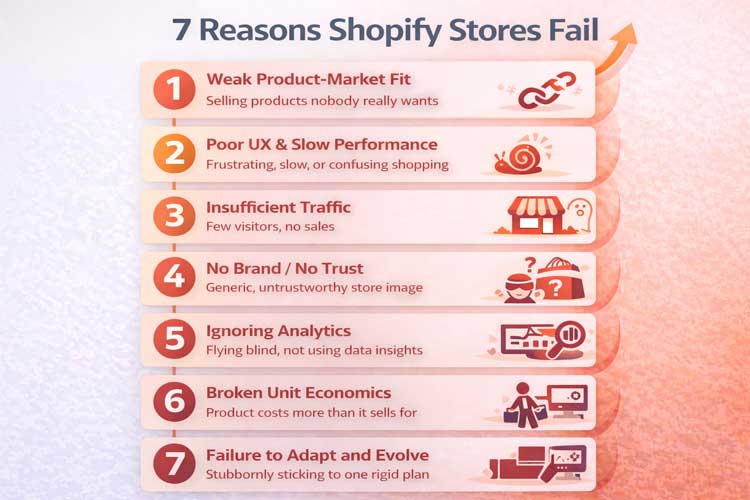
If the platform is powerful and the market is growing, why is the Shopify store failure rate so high? The reasons are remarkably consistent across niches and business models.
1. Weak Product‑market Fit and “Copycat” Products
Many merchants launch by copying trending dropshipping products or selling generic items with dozens of look-alike competitors. Without a clear unique value proposition, strong differentiation, or specific target audience, these stores are forced to compete only on price.
Impact on Shopify success rate:
Price-based competition destroys margins and makes it impossible to afford effective marketing, which tanks the Shopify success rate before the store even gets traction.
What successful stores do instead:
- Target underserved niches with real demand and less direct competition
- Build unique positioning (brand story, quality, curation) rather than commodity positioning
- Price for sustainable margins, not just volume
2. Poor Site Performance and Low Conversion Rates
Slow, confusing, or poorly designed stores kill conversions before shoppers even reach checkout.
- A 1‑second delay in page load time can reduce conversions by 7%, and pages loading in over 4 seconds see dramatically higher bounce rates.
- 79% of Shopify traffic is mobile, yet many stores have clunky mobile experiences, tiny buttons, and hard-to-navigate layouts.
- Poor product images, missing trust signals, unclear value propositions, and complicated checkout processes all increase friction and lower conversion.
Impact on Shopify Success Rate:
A store with slow performance and poor UX will never escape the bottom 50% of Shopify stores, it is nearly impossible to be profitable when conversion rate is under 1%.
What successful stores do:
- Invest in fast, mobile-first design
- Use high-quality product images and clear descriptions
- Simplify checkout to reduce abandonment
- Test and optimize continuously based on data
3. Insufficient or Low‑quality Traffic
The problem:
Some merchants launch a store, post a few times on social media, run a short ad campaign, then assume “Shopify doesn’t work” when sales remain low.
In reality, Shopify success depends on consistent traffic from multiple channels, not random luck or viral moments.
Impact on Shopify success rate:
Stores relying on a single channel (like one paid ad platform) have fragile, expensive growth. When that channel gets saturated or ad costs rise, revenue collapses.
What successful stores do:
- Combine organic search traffic (which converts at ~3.6%, far above platform average) with paid ads, email, content, and partnerships.
- Invest in SEO early, targeting questions like “how many Shopify stores are successful,” niche buying guides, and product comparisons.
- Build email lists and maintain direct relationships with customers.
4. No Brand, No Trust, No Reason to Buy
The problem:
In 2026, shoppers have endless choices. A generic, template-looking store with no clear story or personality struggles to stand out and convert.
Impact on Shopify success rate:
Without trust signals, professional branding, and a memorable brand story, even well-optimized stores convert poorly because shoppers simply do not feel confident buying.
What successful stores do:
- Develop professional branding and clear messaging
- Share their “why” what makes them different and why customers should care
- Display social proof: customer reviews, user-generated content, testimonials
- Use trust badges, return policies, and security certifications
5. Ignoring Analytics and Operating Blind
The problem: Many failing merchants never look at key Shopify analytics like add-to-cart rate, checkout abandonment, conversion rate by device, or return on ad spend (ROAS).
Without this data, it is impossible to know where the funnel is broken or how to improve.
Impact on Shopify success rate:
Blind optimization is like fixing a car engine without a diagnostic tool; you might improve something, but you are just guessing. The most successful stores treat analytics as a roadmap.
What successful stores do:
- Review Shopify Analytics and Google Analytics weekly or monthly
- Track KPIs: conversion rate, AOV, CAC, LTV, cart abandonment
- Run A/B tests on headlines, product page layouts, offers, and ad audiences
- Make data-driven decisions rather than guesses.
6. Broken Unit Economics and Cash Flow Issues
The problem: Even stores with decent sales often fail because the unit economics don’t work: ad costs are too high, product margins are too low, shipping is expensive, or constant discounting kills profit.
For example: A store with $50 AOV, 2% conversion, 2% CAC as a percentage of revenue, and 5% fulfillment cost leaves only about 3–5 cents profit per visitor. Scale and thin margins are a recipe for failure.
Impact on Shopify success rate:
Unsustainable unit economics mean the store burns cash until capital runs out—a major reason why 90% of Shopify stores fail within 24 months.
What successful stores do:
- Price products with 40% gross margin or higher to allow for ads, operations, and profit
- Negotiate with suppliers to improve COGS and margins
- Use tiered shipping thresholds to encourage larger orders and amortize shipping costs
- Continuously monitor and improve CAC and LTV.
7. Failure to Adapt and Evolve
The problem: Ecommerce evolves rapidly. Failing to keep up with trends, whether that is AI-driven personalization, new social platforms, or shifting consumer preferences, leaves stores behind.
Impact on Shopify success rate:
Stores that rely on one outdated strategy (like Facebook Ads in 2024) eventually see declining ROAS as competition increases and platform algorithms change.
What successful stores do:
- Continuously test new traffic channels and platforms
- Adapt their messaging and offers as audience preferences shift
- Invest in emerging trends like AI product recommendations, video content, and conversational commerce
- Stay informed about Shopify updates and new features
Factors That Increase Your Shopify Success Rate
Now that the risks are clear, how do you move your store into the successful minority?
Choose the right niche and business model
Niche and business model strongly influence Shopify success rate.
- Highly saturated, low‑margin niches, like generic phone cases or commodity gadgets, make it much harder to achieve strong profitability.
- Niche brands with a clear audience, unique products, and healthier margins have a better chance of becoming successful Shopify stores.
Whenever possible, avoid competing only on price; instead, compete on brand, quality, positioning, or a tightly defined niche.
Strategies to Increase Your Shopify Success Rate
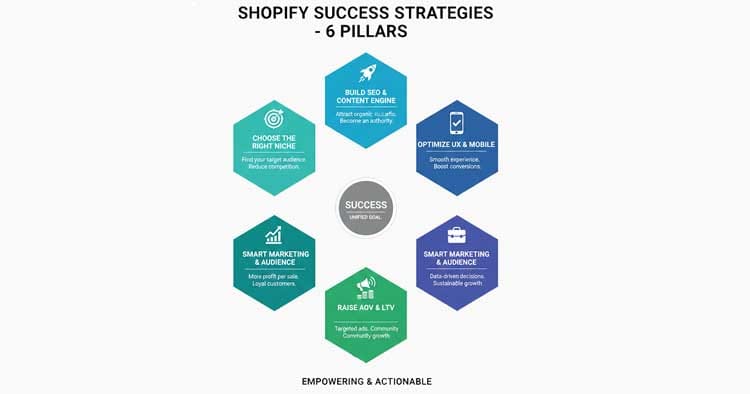
Now that the risks are clear, how do you move your store into the successful minority?
Strategy 1: Choose a Focused Niche with Real Demand and Healthy Margins
Why it matters:
Niche and business model have a major impact on Shopify success rate. Overly broad, low-margin niches (like generic fashion or electronics) make it nearly impossible to compete without massive budgets.
Actionable steps:
- Use search data (Google Trends, Keyword Planner) and social listening (Reddit, TikTok, Instagram) to find underserved niches with clear demand
- Avoid ultra-saturated categories; instead, target niche within the niche (e.g., sustainable activewear for yoga practitioners, not just “activewear”)
- Choose products with 40%+ gross margins so you have room for marketing, operations, and profit.
- Test product‑market fit with a small inventory before scaling.
Strategy 2: Build an SEO and Content Engine for Long‑Term Traffic
Why it matters:
Relying only on paid traffic keeps acquisition costs high and fragile. Successful stores invest early in organic search traffic, which converts better and compounds over time.
Actionable steps:
- Create content around your niche (buying guides, how-to articles, comparisons) that ranks for high-intent keywords.
- Optimize product pages and collection pages for long-tail keywords related to your niche.
- Target research-stage queries like “how many Shopify stores are successful,” “why Shopify stores fail,” and niche-specific buying guides.
- Build internal linking to concentrate authority on high-revenue pages
- Aim to rank on page 1 for 10–20 medium-difficulty keywords within 6–12 months.
As organic traffic grows, your reliance on ads decreases and your Shopify success rate improves because CAC drops.
Strategy 3: Optimize UX, Mobile Experience, and Checkout
Why it matters:
Since most Shopify traffic is mobile and conversion is already low (1.4% average), optimizing the user journey is critical. Even a 0.5% improvement in conversion rate dramatically improves profitability.
Actionable steps:
- Use a mobile-responsive theme and test your store across devices
- Optimize images and lazy-load for fast loading (aim for under 2 seconds)
- Simplify navigation so customers find products in 2–3 clicks
- Streamline checkout: remove unnecessary fields, offer guest checkout, and display trust signals
- Use accelerated checkout options like Shop Pay, Apple Pay, and Google Pay, which can improve conversion by 10–20%
- Test and iterate: use heatmaps and session recordings to see where users drop off.
Strategy 4: Raise AOV and Lifetime Value
Why it matters:
To outperform the average Shopify success rate, each customer must be more valuable for your store than they are for the typical merchant. Higher AOV and LTV allow you to absorb higher CAC while remaining profitable.
Actionable steps:
- Cross-sell and upsell: Recommend complementary or higher-value products on product pages, in the cart, and post-purchase.
- Bundle products: Offer “frequently bought together” bundles or themed bundles (e.g., beginner’s starter kit) at a slight discount that increases total transaction value.
- Volume discounts: Incentivize larger orders with tiered pricing: “Buy 2, get 10% off; buy 3, get 15% off”.
- Email marketing: Build email flows (welcome series, post-purchase, win-back campaigns) that encourage repeat purchases.
- Loyalty programs: Reward repeat customers with exclusive offers, early access, or points-based discounts.
Aim to improve AOV from $85 to $100–$110 and repeat purchase rate to 25%+. The math compounds quickly in your favor.
Strategy 5: Invest in Smart Marketing That Builds Audience, Not Just Traffic
Why it matters:
Paid ads alone are expensive and fragile. Successful stores balance paid ads with owned channels (email, SEO, content, direct).
Actionable steps:
- Email marketing: Build an email list from day one using pop-ups and lead magnets. Email can achieve 5%+ conversion rates and 20%+ ROAS
- Content marketing: Publish 1–2 blog posts per month, targeting niche keywords and questions your audience is asking
- Organic social: Focus on platforms where your audience hangs out (Instagram, TikTok, Pinterest, Reddit) and build a community, not just a broadcast channel
- Paid ads: Use smart targeting and retargeting, but test to ensure ROAS is healthy (3:1 or higher)
- Partnerships and affiliates: Collaborate with complementary brands, micro-influencers, and affiliate partners to expand reach without increasing ad spend.
Strategy 6: Treat Shopify Like a Real Business, Not a Quick Experiment
Why it matters:
The merchants who end up in the top 5–10% Shopify success rate group treat their store like a long-term business with clear goals, budgets, and metrics—not as a side project they hope will go viral.
Actionable steps:
- Set clear goals: Define what success looks like (e.g., $10,000/month revenue, 5% profit margin, break-even in 6 months).
- Budget wisely: Allocate budget for inventory, marketing, operations, and contingency, and stick to it.
- Track metrics: Review KPIs weekly or monthly, not randomly.
- Reinvest profits: Use profits to improve product, design, marketing, and customer experience.
- Build systems: Document processes for fulfillment, customer service, marketing, and operations so the business scales without you doing everything.
- Stay committed: Most businesses take 6–12 months to gain traction; expect a runway of at least 3–6 months of modest or negative cash flow.
Essential Shopify Apps to Accelerate Your Success Rate
Implementing all these strategies from scratch takes significant time and technical expertise. To accelerate your progress and improve your Shopify success rate faster, you can leverage purpose-built Shopify apps that automate tracking, optimize conversions, and enhance customer experience.
The following apps directly address the seven failure reasons and six success strategies discussed above:
Analytics & Data-Driven Decision Making

Analyzely – Google Analytics 4 Integration
⭐ 4.6/5 (106 reviews)
- What it does: Easily track visitor behavior and conversion by integrating GA4 into your Shopify store
- How it helps your success rate: Solves failure reason #5 (ignoring analytics). Without proper analytics, you operate blind. Analyzely connects your store to GA4 so you can see exactly where visitors drop off, which traffic sources convert best, and which pages need optimization.
- Impact: Stores using GA4 tracking improve conversion rates by 15-25% because they make data-driven changes instead of guesses
- Free plan available
GroPulse GTM & Data Layer
⭐ 4.9/5 (38 reviews)
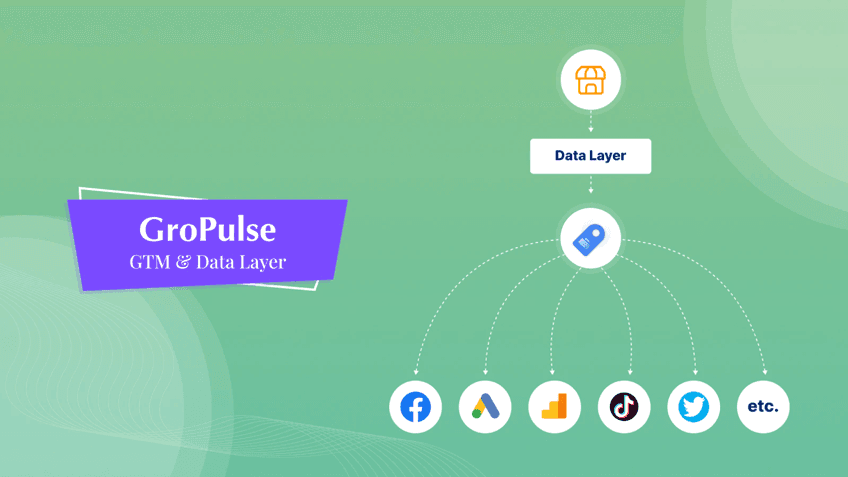
- What it does: Server-side GTM for GA4, Facebook, TikTok & 5+ platforms with advanced data collection
- How it helps your success rate: Goes deeper than standard GA4 tracking. Implements server-side tracking to capture data accurately across all marketing channels, giving you a complete view of which ads and campaigns actually drive sales.
- Impact: Eliminates data blindness across platforms—you know your true ROI on every dollar spent
- Free plan available
AdTrack – Google Ads Tracking
⭐ 4.2/5 (10 reviews)

- What it does: Track Google Ads performance and optimize with AI diagnostics
- How it helps your success rate: Helps you avoid wasting money on unprofitable ads (part of strategy #5 Smart Marketing). AI diagnostics identify underperforming keywords and suggest optimizations.
- Impact: Improves ROAS on Google Ads by 20-30% by identifying optimization opportunities automatically
- Free plan available
SEO & Search Visibility
GP JSON-LD Schema & AI SEO
⭐ 4.8/5 (47 reviews)

- What it does: Rich snippets & AI-powered SEO tools for more Google clicks
- How it helps your success rate: Directly supports strategy #2 (Build an SEO & Content Engine). Structured data markup helps your products appear in Google search results with rich snippets (images, ratings, prices), which increases click-through rate and drives more free traffic.
- Impact: Stores with proper schema markup see 20-30% more clicks from Google search at zero ad cost
- Free plan available
Nolndexly – Sitemap Manager & Meta Tags
⭐ 4.3/5 (20 reviews)

- What it does: Easily control NoFollow & NoIndex meta tags of your store + XML sitemap management
- How it helps your success rate: Prevents wasted crawl budget on low-value pages. Ensures Google crawls and indexes only your revenue-generating pages (products, categories), not duplicate or thin content.
- Impact: Faster indexing of new products and better SEO crawl efficiency = faster ranking and more organic traffic
- Free plan available
Social Proof & Trust Signals
GroPulse Google Reviews
⭐ 4.3/5 (23 reviews)

- What it does: Boost sales with authentic customer feedback from Google Map and display reviews on your store
- How it helps your success rate: Directly addresses failure reason #4 (No brand, no trust). Real customer reviews dramatically increase conversion rates because buyers trust peer feedback more than marketing claims.
- Impact: Stores displaying authentic reviews see 25-30% higher conversion rates
- Free plan available
SalesPulse – Sales Pop Up
⭐ 5.0/5 (1 review)

- What it does: Add dynamic sales pop-ups to your store for social proof (e.g., “John just bought…”)
- How it helps your success rate: Creates urgency and trust in real-time. When shoppers see other customers buying, they’re more likely to buy too (social proof + FOMO).
- Impact: Improves conversion rate by 5-15% and builds trust with new visitors
- Free plan available
HelpMate – FAQ & Help Center
⭐ 5.0/5 (1 review)
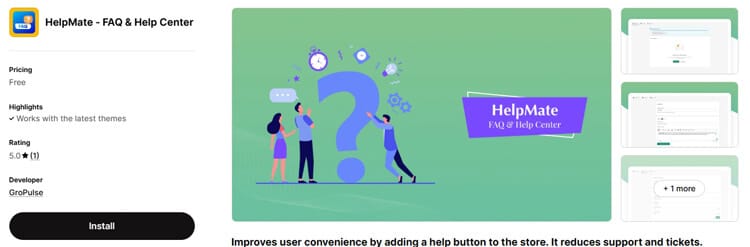
- What it does: Create FAQs for quicker assistance and reduce support time
- How it helps your success rate: Improves UX (strategy #3) by answering customer questions before they contact support. Reduces friction and builds confidence in your product.
- Impact: Increases conversion rate by reduci
- ng uncertainty + saves support time + improves customer satisfaction
- Free
Conversion Optimization & AOV
GP Free Shipping Bar
⭐ 4.6/5 (15 reviews)
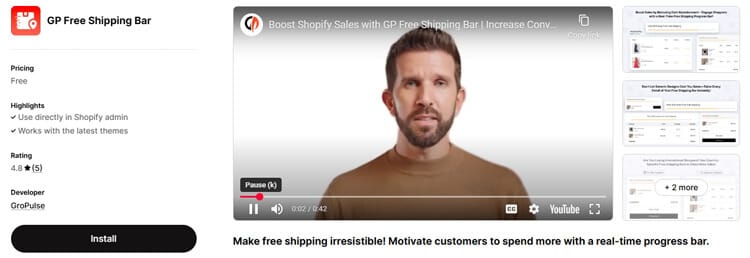
- What it does: Dynamic customizable free shipping bar with advanced targeting
- How it helps your success rate: Directly supports strategy #4 (Raise AOV & LTV). When customers see “Free shipping on orders over $100,” they’re incentivized to add more items to reach the threshold, increasing AOV.
- Impact: Increases average order value by 10-20% and improves customer satisfaction (free shipping perception)
- Free plan available
GP – Wishlist & Upsell Suite
⭐ 4.8/5 (12 reviews)
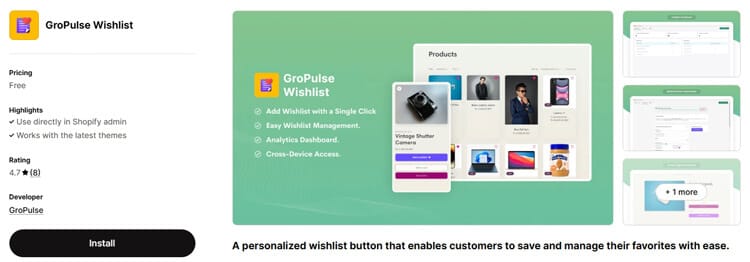
- What it does: Boost sales with wishlists, upsells, bundles & reminders
- How it helps your success rate: Core AOV strategy. Wishlists capture intent, while upsells and bundles increase the value of each transaction. Automated reminders drive repeat purchases.
- Impact: Increases AOV by 15-25% and repeat purchase rate by 10-20%
- Free plan available
Multi-Channel Advertising
Pixee – Multi Pixel & Meta Ads
⭐ 4.9/5 (67 reviews)

- What it does: Facebook, TikTok & Pinterest pixel + CAPI & product feed sync in one app
- How it helps your success rate: Supports strategy #5 (Smart Marketing). Proper pixel setup ensures you’re tracking conversions accurately across all paid platforms. CAPI (Conversions API) bypasses ad blockers for better data.
- Impact: Improves ad targeting accuracy and ROAS by 20-30% because Facebook/TikTok optimize toward actual sales, not estimated conversions
- Free plan available
Technical Implementation
CodeUp – Add Custom Code
⭐ 4.8/5 (11 reviews)

- What it does: Easily insert custom header & footer code to your store
- How it helps your success rate: Speeds up implementation of tracking pixels, analytics, custom scripts, and integrations without coding. Makes it fast and easy to add tools that drive success.
- Impact: Enables faster deployment of optimization tools = faster time to profitability
- Free
Why These Apps Matter for Shopify Success Rate
Most failed Shopify stores never achieve success because they lack the infrastructure to track performance, optimize conversions, and build trust. By using a comprehensive suite of these tools, you:
- Make data-driven decisions instead of guessing (using Analyzely, GroPulse GTM, AdTrack)
- Improve conversion rate faster through tested optimization tactics (using SalesPulse, HelpMate, Free Shipping Bar)
- Build trust and social proof that lifts AOV (using GroPulse Reviews, SalesPulse)
- Increase AOV & repeat purchases (using Free Shipping Bar, Wishlist & Upsell Suite, email tools)
- Reduce wasted ad spend by targeting only profitable campaigns (using Pixee, AdTrack, GroPulse GTM)
- Rank higher in search and drive free, sustainable traffic (using GP Schema, Nolndexly)
Stores using a coordinated set of these tools consistently achieve:
- 2-3x higher conversion rates (from 1.4% → 3-4%)
- 20-30% higher AOV (from $85 → $110+)
- Better ROI on ads (3:1 ROAS vs. 1.5:1 for basic stores)
- Faster path to profitability (12-18 months instead of 24+)
🚀 Ready to skyrocket your Shopify store to success?
🚀 Unlock the secrets to success and boost your sales 📈 with ShopiBuffet’s expert services. Don’t miss out, get started now!
Frequently Asked Questions
What is the success rate of Shopify stores?
Most recent analyses estimate that the Shopify success rate is around 5–10%, referring to merchants who achieve long‑term profitability and stable growth rather than just a few sales.
How many Shopify stores are successful?
Shopify has approximately 6.5 million active stores as of Q3 2025, of which roughly 5–10% (325,000–650,000) are estimated to be truly profitable. This aligns with the broader ecommerce ecosystem, where small business failure is common. See Red Stag Fulfillment’s detailed store count analysis for more information.
Why do most Shopify stores fail?
Most Shopify stores fail due to:
1. Lack of clear business strategy and product‑market fit
2. Poor site performance and low conversion rate
3. Insufficient or low‑quality traffic
4. Weak branding and trust signals
5. Ignoring analytics and financial planning.
Are Shopify stores really profitable?
Yes, many successful Shopify stores are highly profitable, and some brands scale to six or seven figures per year in revenue. However, this is not typical, and only a small percentage of stores achieve this level due to the challenges described above.
How can I increase my Shopify success rate?
You can improve your Shopify success rate by:
1. Choosing a focused niche with healthy margins
2. Investing in SEO, content, and email marketing
3. Optimizing UX, mobile performance, and checkout
4. Increasing AOV and LTV while keeping CAC under control
5. Treating your store like a real business with clear goals and budgeting
How long does it take to achieve success on Shopify?
Most successful Shopify stores take 6–12 months to generate consistent sales and 12–24 months to reach true profitability. Those with strong product-market fit, effective marketing, and data-driven optimization often scale faster. Expect a runway of at least 3–6 months where cash flow may be tight. Cirklestudio’s analysis provides detailed timelines for different store types.
Conclusion: Your Roadmap to Shopify Success
The real Shopify success rate of 5–10% reflects harsh economic reality: building a profitable online business is harder than launching a store. But it is not impossible.
The gap between failure and success is not luck; it is strategy and execution:
- Failure comes from weak niches, no marketing, poor UX, ignoring data, and broken unit economics
- Success comes from choosing the right niche, building an audience, optimizing conversion, improving AOV, and treating Shopify like a real business
If you apply the strategies in this guide, starting with a strong foundation, investing in organic traffic, optimizing every part of the funnel, and staying committed to long-term growth, you can significantly improve your odds of joining that successful 5–10% of Shopify stores.
Success on Shopify is achievable for entrepreneurs willing to treat it like a business, not a lottery ticket.