

Quick Answer / TL;DR
To test your Shopify store checkout safely without spending money, navigate to Settings > Payments, then either enable Test Mode within your Shopify Payments setup or activate Shopify’s native Bogus Gateway. Use simulated credit card numbers to complete a dummy transaction, verify fulfillment logic, and then deactivate test mode before going live.
Before launching a Shopify store, you should test the full buying journey exactly the way a real customer would experience it. A store can look ready on the front end, but still have hidden problems with checkout, payment settings, shipping rates, taxes, discount codes, order emails, or fulfillment apps.
Testing your Shopify store helps you catch those issues before they cost you real sales. By placing a safe test order, you can confirm that customers can browse products, add items to the cart, complete checkout, receive order notifications, and trigger the correct backend workflow.
In this guide, you’ll learn how to test your Shopify store step by step using Shopify’s official testing options, including Bogus Gateway and Shopify Payments Test Mode.
Why Testing Your Shopify Store Matters Before Launch
Launching an online store without conducting an end-to-end simulation is one of the most expensive mistakes an eCommerce entrepreneur can make. Broken checkout paths, miscalculated shipping tiers, or malfunctioning discount mechanisms will drive hard-earned traffic away in seconds, permanently hurting your brand’s reputation.
Systematically testing your digital storefront allows you to uncover structural glitches, slow-loading assets, and configuration errors before a single real customer encounters them. This step-by-step tutorial provides the framework and official configuration tools to thoroughly audit your checkout pipeline, product catalog, fulfillment workflows, and user experience securely.

Bring your ideas to life for $1/month
The future of business is yours to shape. Sign up for a free trial and enjoy 3 months of Shopify for $1/month on select plans.
How to Test Your Shopify Store: 7-Step Checklist
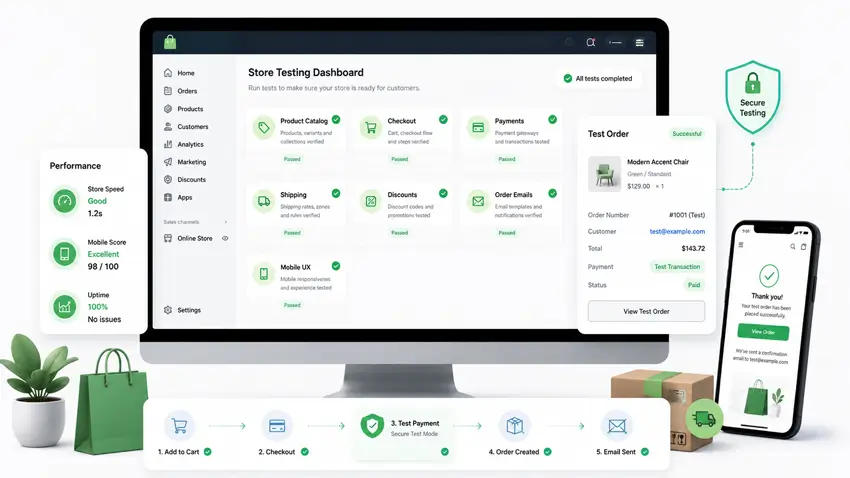
Here is the complete process you should follow before launching or updating your Shopify store:
- Prepare a safe testing setup
- Test your product catalog
- Test checkout and payment processing
- Test shipping, delivery, and fulfillment rules
- Test discount codes and promotions
- Test mobile UX, navigation, and store speed
- Review order emails, returns, cancellations, and test records
Phase 1: Preparing Your Shopify Test Architecture
Before altering configurations or placing dummy orders, you must understand how to construct a safe evaluation framework.
Contrary to popular belief, standard Shopify accounts do not feature a native, single-click button to duplicate a complete operational backend database (including customers, historical orders, and localized settings). Instead, merchants use two distinct techniques to isolate their testing:
- For Frontend Layout and Design Changes: Duplicate your live theme via Online Store > Themes. Click the three dots next to your active theme and select Duplicate. This generates an isolated staging theme where you can test app visual elements and design changes safely without affecting your public layout.
- For Backend, Payment, and Catalog Settings: Test directly on your main dashboard before removing your storefront’s entrance password, or leverage a dedicated development store via a Shopify Partner account if you are engineering extensive structural customizations.
Critical Safety Precautions Before Testing
Use Safe Test Email Protocols: When filling out customer details during dummy checkouts, always use an email address that terminates with the domain @example.com. Shopify’s internal database identifies this domain to safeguard your real accounts from triggering spam-monitoring filters or skewing your customer engagement data.
Deactivate Automated Fulfillment Services: If your store connects to automated print-on-demand networks, third-party logistics providers (3PLs), or dropshipping applications, pause these integrations before processing test purchases to avoid triggering accidental fulfillment requests or production charges.
🚀 Ready to skyrocket your Shopify store to success?
🚀 Unlock the secrets to success and boost your sales 📈 with ShopiBuffet’s expert services. Don’t miss out, get started now!
Phase 2: Testing Your Digital Product Catalog
Your product catalog forms the foundation of your customer journey. Every variable choice, pricing change, and search query must process flawlessly.
1. Verification of Asset and Visual Display Accuracy
Open your store’s public preview mode and systematically audit individual listings. Check that high-resolution product imagery scales correctly and loads quickly across multiple screen types. Ensure that listed retail values match your intended pricing strategy, and confirm that tax-inclusive flags appear correctly where mandated by localized regulations.
2. Complex Variant Mapping and Dynamic Pricing Logic
If your products feature custom attributes, you must verify that buyers can seamlessly adjust options like size, color, or material. Check that choosing alternative options dynamically updates the main product image and adjusts the retail price accurately. If you have engineered a complex sizing matrix, ensure your backend setup functions flawlessly by reviewing how to add size options on Shopify.
3. Intent Search Accuracy and Filter Performance
Type your primary keywords into the search box to verify that the internal search engine serves relevant results. Test every sidebar collection filter, sort selector, and tag taxonomy. If you rely on physical scanning integrations for retail operations or warehouse inventory tracking, make sure to properly create barcodes in Shopify to guarantee smooth cross-channel synchronization.
4. Cart Additions and Dynamic Customizations
Add single and multiple items to your cart directly from various collection layouts and product pages. Confirm that AJAX cart sidebars slide open cleanly, item counts increase correctly, and custom personalization text fields attach to the line item database without any configuration issues.
Phase 3: Testing Checkout and Payment Processes
The checkout pipeline is the most critical conversion point of your digital storefront. You can validate your transaction workflow using two primary methods: Shopify’s native Bogus Gateway or the built-in Shopify Payments Test Mode.
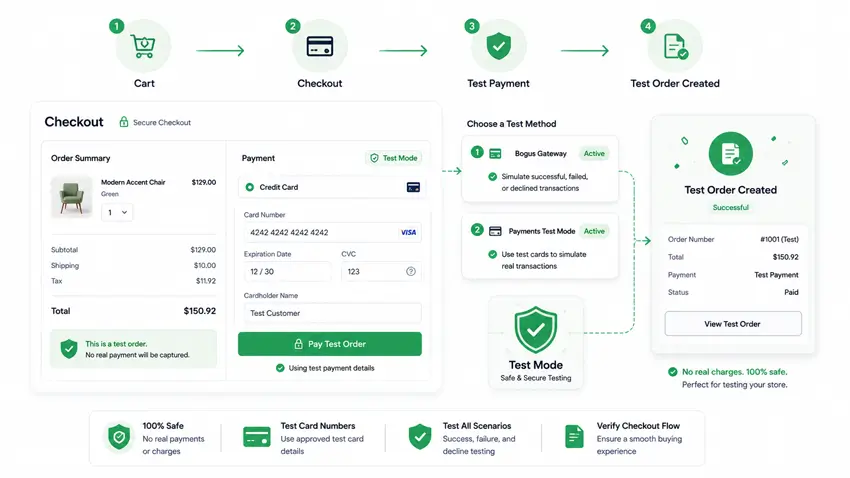
Method A: Activating Shopify’s Bogus Gateway
The Bogus Gateway is a universal, simulated processor built into every account, ideal for stores where Shopify Payments isn’t active or supported.
- From your Shopify admin, go to Settings > Payments.
- If you have an active, live credit card processor enabled, click Manage > Deactivate to turn it off temporarily.
- Open the comprehensive directory of providers. If eligible for Shopify Payments, select See all other providers; if ineligible, select Choose a provider.
- Locate and select (for testing) Bogus Gateway, click Activate (for testing) Bogus Gateway, and hit Save.
To simulate different checkout outcomes, use the following exact inputs when entering payment details at your store’s public checkout:
| Simulation Target | Cardholder Name Input | Credit Card Number Input | Security Code (CVV) | Expiration Date |
| Approved Transaction | Bogus Gateway | 1 | Any 3-digit number | Any future date |
| Declined Transaction | Bogus Gateway | 2 | Any 3-digit number | Any future date |
| System/Gateway Error | Bogus Gateway | 3 | Any 3-digit number | Any future date |
Method B: Activating Shopify Payments Test Mode
If your business is located within a supported territory and you utilize Shopify Payments as your primary financial gateway, follow these activation steps:
- Navigate to Settings > Payments within your Shopify administrator panel.
- Locate the core Shopify Payments container box and click Manage.
- Scroll to the bottom of the management dashboard to locate the dedicated Test Mode section block.
- Check Enable test mode and save your dashboard configuration.
⚠️ Merchant Caution: While Test Mode is active, real customers cannot process real credit card payments on your store. Execute your tests quickly and disable Test Mode immediately afterward to avoid losing real sales.
To verify successful order captures, use the following official test credit card credentials during your checkout testing:
| Card Brand | Test Card Number String | CVV Code Format | Expiration Date Parameter |
| Visa | 4242 4242 4242 4242 | Any 3 digits | Any valid future date |
| Mastercard | 5555 5555 5555 4444 | Any 3 digits | Any valid future date |
| American Express | 3782 8224 6310 005 | Any 4 digits | Any valid future date |
| Discover | 6011 1111 1111 1117 | Any 3 digits | Any valid future date |
Simulating Accelerated Digital Wallets
If you want to test accelerated checkouts, you can also validate your Shop Pay integration inside Test Mode. To do this, link an official test card number directly to your Shop Pay profile, and type test_card into the standard Nickname field. This signals Shopify’s sandbox to process the accelerated order securely without charging your actual account.
Phase 4: Testing Shipping, Delivery, and Fulfillment Logistics
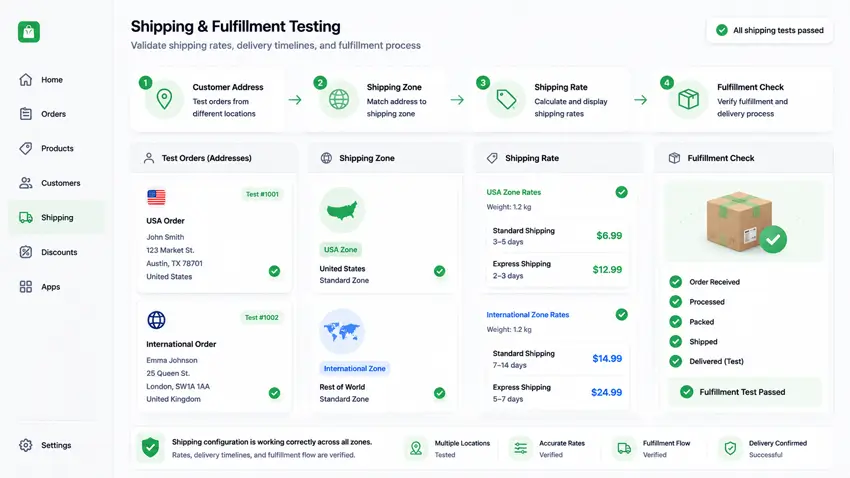
Once an order processes successfully, your operational backend must execute logistics calculations without errors.
1. Multi-Zone Shipping Rate Adjustments
Place separate test orders using distinct customer delivery addresses spanning different shipping regions, zip codes, and countries. Check that your tiered flat rates, weight-based calculations, or carrier-calculated APIs match your exact fulfillment rules.
2. Physical Logistics and Label Verification
Check that tax liabilities display correctly according to domestic or international cross-border compliance laws. If you manage fulfillment manually, print out sample records to verify details before packing. For automated shipping label creation, review the guide on how to print shipping labels on Shopify to ensure your printer configurations match carrier layouts perfectly.
Phase 5: Testing Discount Codes and Promotions
Marketing campaigns fail when promotional configurations do not work correctly at checkout.
- Fixed Value and Percentage Validation: Generate distinct alphanumeric test codes (e.g., TEST20) inside your admin dashboard. Apply them at checkout to confirm that total values decrease by the exact percentage or fixed dollar amount configured.
- Boundary Conditions and Minimum Threshold Restrictions: Set up strict usage limits, such as a minimum spend of $50 or collection-specific requirements. Try to trigger the discount with invalid cart combinations to verify that Shopify’s checkout successfully blocks the markdown and prompts the user with the correct error message.
- Visual Promotional Banners: To announce active promotions clearly across your store, learn how to add a sale banner on Shopify and verify that its layout looks great on all devices.
Phase 6: Optimizing the User Experience (UX) and Store Speed
A functional checkout is useless if your storefront layout is slow or difficult to navigate.
1. Cross-Device Visual Auditing
Open your preview storefront across different physical smartphones, tablets, and desktop browsers (Chrome, Safari, Edge). Test every link, dynamic navigation menu dropdown, footer element, and call-to-action button. If you spot overlapping blocks or misaligned mobile modules, read our guide on how to edit mobile view on shopify to clean up your layout components.
2. Page Loading Performance Optimization
Use tools like Google PageSpeed Insights to monitor your homepage and product templates. Compress unoptimized assets, convert raw image file structures into light .webp formats, and deactivate redundant third-party applications to keep your loading speeds lightning-fast.
Phase 7: Post-Purchase Audits and Cleaning Up Test Records
Once you finish running your store simulations, you need to clean up your dashboard to keep your business analytics accurate.
1. Reviewing Automated Transaction Emails
Log in to your safe test email account and inspect the automated order confirmations, order receipts, and shipping notifications sent by your store. Ensure that logos scale properly, fonts read cleanly, and dynamic variables (like names and order numbers) populate without issues.
2. Processing Sample Returns and Cancellations
Open your core dashboard administration screen, locate your latest dummy order records, and practice processing a cancellation. Issue a full and partial return to ensure your inventory levels automatically adjust back up. For a complete understanding of how this impacts your financial accounting, read our analysis on the Shopify refunds process.
3. Deleting Test Transactions
To permanently remove test records from your administration screens, open the individual order page, click Actions, and select Delete. Note that only transactions run through Shopify Payments Test Mode or the Bogus Gateway can be permanently deleted; test orders placed via third-party providers can only be archived.
🚨 Final Launch Step: Once all checks pass, go back to Settings > Payments, turn off the test mode switch, and click Save. Your Shopify storefront is now fully optimized, verified, and ready to capture real sales!
Frequently Asked Questions
Can I place a test order on Shopify without a paid plan?
No. Shopify requires you to select an active monthly plan before testing its online checkout pipeline. If your store is in a development trial state, you cannot process real or simulated transactions through public checkouts until an active subscription plan is chosen.
Do Shopify test orders affect my sales reports and dashboard analytics?
Simulated test orders processed while Shopify Payments Test Mode or the Bogus Gateway are active do not appear in your financial payouts, sales summaries, or core reporting analytics. This ensures your true business metrics stay completely accurate.
Why isn’t PayPal displaying as a payment option when I test my checkout?
When you activate Shopify’s internal payment test modes, alternative third-party express checkouts—such as PayPal Wallet—are automatically hidden from the checkout screen to prevent real monetary charges.
How do I simulate a credit card decline to check my store’s error messages?
If you are testing via Shopify Payments Test Mode, use the test card number string 4000 0000 0000 0002 to trigger an authentic card decline. If you are using the Bogus Gateway, simply type 2 into the card number entry field.
Can I delete test orders from my Shopify dashboard after completing them?
Yes. You can permanently delete test records if they were processed through the Bogus Gateway or Shopify Payments Test Mode. Open the individual order within your admin panel, archive the order first, scroll to the bottom of the page, and click Delete this order.
Grow Your eCommerce Business with Valuable Resources, Tools, and Lead Magnets
- Bring your ideas to life for $1/month
- One platform that lets you sell wherever your customers are—online
- Create a beautiful eCommerce website
- Start for free, then enjoy $1/month for 3 months
- Build your own website in a few steps
- Create a website in minutes easily, secure method
- Turn what you love into what you sell
- Discover the Shopify Point of Sale
- AI Based Business Name Generator
Need Help Testing Your Shopify Store Before Launch?
If setting up secure payment testing environments, handling complex variant paths, or building reliable multi-tiered shipping matrices feels overwhelming, let professional developers handle the technical setup.

The specialist engineering team at ShopiBuffet focuses on end-to-end store optimization, theme management, and setup auditing. We can review your custom systems to make sure your checkout works flawlessly from day one.
🚀 Connect with the ShopiBuffet Support Team Today to ensure a successful, high-conversion launch!
Final Words
Testing your Shopify store is not just a pre-launch checkbox. It is a continuous optimization framework. eCommerce environments evolve rapidly, and routine assessments ensure that recent application additions, payment gateway updates, or styling updates do not break your purchase path.
By systemizing your catalog audits and processing secure transaction testing via Shopify’s integrated sandbox components, you protect your conversion metrics and create a frictionless environment for incoming traffic.